June 5, 2010

The Power of Positive Feedback

Having been much in the company recently of someone who not only gives genuine positive feedback in abundance but also inspires other people to do likewise, I’m left to wonder why this isn’t a more common practice. Pat Parelli says that humans and dogs are motivated by praise, recognition, and material objects. Yet although two of those three have a huge effect on the receiver with little cost to the giver, they are not often in evidence. Why?

In part, I think that, for Type A personalities especially, it’s so much more a habit to focus on what still needs to be done instead of what has been accomplished. It’s also a constant challenge, as Parelli acknowledges, to “be particular without being critical.” But what a difference it makes when you can manage it! It's the key to so much--even to horses, who are not themselves silly enough to care much for such abstractions as praise and recognition. They do care, though, that you don't just keep hounding them in your quest for perfection (which they are also intelligent enough not to care about), and they certainly get that their lives have more of what they *do* care about (comfort and play) when their human is less critical.

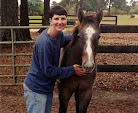
For me, I can weigh how much power positive feedback has by the fact that I remember just about every instance of it that I have gotten during my training of Lupin in the past 9 years. Of course, my sensitivity to it was heightened early on by the fact that, before Lupin, I had never raised a horse from a foal, and I was completely paranoid that I was going to do something wrong and screw him up for life, with the possibility of dire consequences for both him and myself.

And then there’s the fact that having a small foal is a lot like being pregnant: everybody has a strong (and often different) idea about what you should be doing and how you should be doing it, and they’re more than happy to share. When you’re a little uncertain yourself (as I very much was since I was brand new to Parelli as well as to colt starting), it’s overwhelming.

So the instances in which an outsider just said to me, “Marian, you’ve done a really good job with him,” stand out like little oases in a vast desert of uncertainty and doubt about what I was doing. They were moments that allowed both Lupin and me to breathe a sigh of relief because, for a space, I took the pressure off him and just relaxed.

Parelli’s goal is for his students to be positive, progressive, and natural while using love, language, and leadership with their horses. None of this has come easily for me with Lupin. When he challenges my leadership, it’s difficult for me to hold on to the love, and all the abilities that love gives you: patience, and forgiveness, and strength. Learning the natural language of horses is a humbling experience that makes you realize how very little you know about horses, whether you’ve spent a lifetime with them or not, and being truly progressive requires a level of creativity and flexibility that I don’t even begin to have, but that I am beginning to work toward.

But for now, being positive begins to seem like the thing on which all the others hinge. It is the fulcrum on which to balance on one side the quest for excellence, which you can’t pursue without a positive goal, and on the other, the ability to appreciate what you and your horse have already achieved--without which you will never be able to genuinely acknowledge your horse’s “try’s.”

May 31, 2010

So it begins

I have had the idea to write about my relationship with Lupin ever since he was born, as I knew that my first time raising a colt was bound to be an experience filled with the kind of personal growth that can always be converted into good narrative value. But I’m a born procrastinator, and so it took me 8 years to seriously start thinking about what I might write.

At that point (which was last summer), I hatched the hare-brained scheme to take Lupin to Colorado for a month-long course at the Parelli Center. Colorado, note, rather than Florida (which is days closer) and a course that is essentially designed for Level 3/4 students while Lupin and I are still happily plugging away in Level 2. Yep. That seemed like good narrative potential for sure.

But did I mention that I’m a procrastinator? While “My Year of Not Getting Ready to be Totally Overwhelmed at the Parelli Center” would have been a catchy idea for a blog . . . well, somehow it didn’t happen. So now we’re more like into “My Last Few Months of Cramming for my Parelli Course, Most of Which I’ll Spend Writing this Blog Instead.”

So as not to waste further time, I’ll just quickly introduce us. Lupin and I both have playfulness and stubbornness as key personality traits. We are, I strongly believe, perfect partners for each other—or at least the kind of partners that we each mutually deserve to have. But the problem is that I am more playful in virtually every area of my life than I am with my horse, who is the one being that would most appreciate it. He deals with that situation by creating his own games to play with me, which always seem to highlight my areas of greatest inadequacy. And feelings of inadequacy do not readily lend themselves to a sense of carefree playfulness. And so the downward spiral begins.

On the stubbornness front, however, I still feel pretty competitive. After all, I’m still here. But Lupin likes to give me a run for my money there too. Pushing my emotional buttons is, in fact, one of his favorite games, just as I myself have been known to push other people’s buttons for my own amusement. It is possible that Lupin would have been more aptly named if I had called him “Karma.”

Despite all of this, however, I see glimpses now and then of something more than Lupin and me battling it out or, on our less inspired days, poking around in half-assed apathy. Every once in a while, Lupin really does feel like my partner—a partner in crime, or at least in happy chaos, and a steadfast being there to back me up when I don’t quite come through. And it’s for that reason, more than any other, that I stick with Parelli: because I want to see where Lupin and I could go together.

For non-Parelli folks, Parelli is both a person and the horse-training system founded by Pat Parelli—though it’s actually human-training that Parelli does. Parelli operates on the assumption that it is almost always the human, rather than the horse, that needs to learn more, and what humans need to learn is more horse savvy. Students study in four areas:

1. On Line: on the ground with a halter and different lengths of line on the horse

2. Liberty: on the ground with nothing on the horse

3. Freestyle: mounted with the focus being to use only your focus—your eyes—to guide your horse

4. Finesse: mounted with a high level of precise movement achieved through reins, etc. (similar to dressage)

Parelli calls itself a journey, and it is. It’s a journey of self-discovery and self-mastery, and also of relationships and leadership. The principles apply across all areas of life, but horses make them more immediate, and more real, since horses are nothing if not honest, and also big enough that you can’t ignore the potentially disastrous consequences of bad decision-making.

For all of these reasons, I tend to wax analytical when I’m on the topic of my horse. Once more, playfulness loses out. Perhaps by the end of the blog, I will have achieved more of a balance there. For now, those intrepid souls who choose to continue reading this blog can expect a rather bland mix of pop-psychology, self-analysis, and general rambling, peppered, one can only hope, with the occasional interesting anecdote.