March 3, 2014

Horsenality/Humanality course notes (part 1): The four humanality types

As I mentioned in my last post, I just finished the Horsenality/
Humanality course with Linda Parelli and Patrick Handley a few weeks ago. In a way, I've been waiting for this course for years, ever since I tried to piece together a little more information—particularly on the humanality end of things—after my Fast Track. (Here is the blog post where I made some decent headway with that effort.)

I was even more inspired to keep learning about humanality and horsenality after Patrick and Linda's excellent savvy club DVD of April 2013. 

There are two things in particular I love about that DVD. First, the information in it has been huge in helping me to understand myself and others in a more positive and accepting way. And second, Linda and Patrick are uproariously funny and delightful together. When I heard they were teaching a course, I didn't so much make a decision to attend as just do the only obvious thing: sign up and go!

And the course did not disappoint. I soaked in information as fast as I could, and I thoroughly enjoyed the anecdotes and humor throughout. It feels greedy to keep so much wonderfulness to myself, so I'm going to do my best to share a lot of it here, including, as much as possible, the bits that really tickled me. 

But first I want to start with what Pat said. He was sitting on his horse and rambling on, as he does, joking and talking about nothing in particular, when he suddenly turned serious and said, as he does, something really amazing. And it was this: "Horsenality/Humanality is not an excuse: it's a strategy and a starting point."

I think we can all worry about being pigeon-holed or about having our depth and complexity minimized by schemata like the humanality types. Conversely, we can all be seduced by the possibility of establishing a clear identity and then never stretching ourselves beyond it.

Yet the horsenality and humanality types aren't intended to limit ourselves or others. Rather, they are meant to give us, as Pat said, a starting place—a springboard to greater understanding and compassion for both ourselves and others, be they human or equine. They give us as well the tools—the strategies—we need to be able to communicate effectively with those who are different from ourselves. And at their very best, they give us the opportunity to live more expansively by creating an understanding of our starting point and mapping out where we might want to go next in our quest to be our best selves—as well as how we might get there. 

Everyone has their own journey and their own maps to follow, and I'm a big believer in letting folks get on with their journeys in the way that suits them best. So I don't want to insist that studying things like humanality is the only way. 

But I'm also a big believer that awareness about things like the different humanality types can make a real difference—especially in the amount of human kindness out there—and it's to that end that I'm sharing this information. (And also because I just freaking love this stuff!).

I'm going to start with an overview on the humanality side of things in this post, and then in future posts move on to my notes about interactions, triggers, and strategies, as well as the horsenality stuff. 

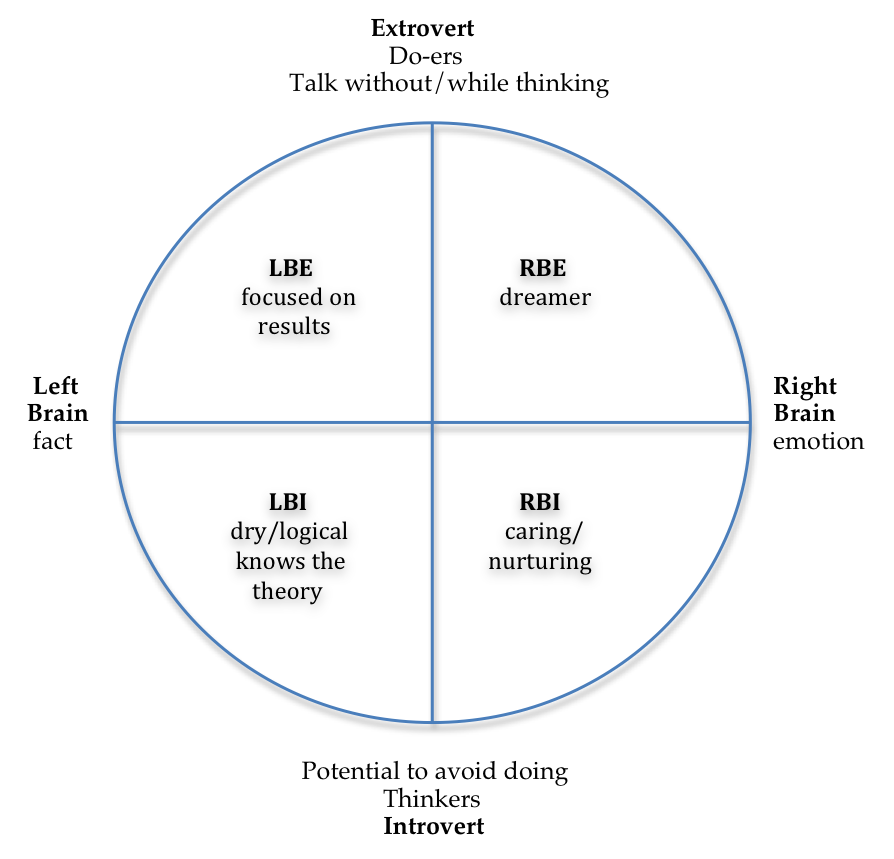
Here's the basic humanality breakdown:


 Left Brain Extroverts
Robert Downey, Jr. as Iron Man
is like a double helping of LBE.

 
LBE's are motivated by achievement and focused on results: "Get to the point and do it now!" They are active ("When things are happening, we're having a good day!") and competitive ("You play to win! Who cares if the kid you're playing against in Monopoly is only 4?"). They are confident and assertive and have a great capacity to believe in themselves, and generally to convince others as well . . . even when they're wrong. Patrick described a trail ride with his wife where they got lost, except that she didn't believe she was lost: "She was lost and convinced that she knew the way home. That's a bad combination." Patrick, having been married to an LBE for a long time, did not, at least, fall into the trap of believing that, because she was confident, she was also right. This is a big danger for other people around LBE's, to whom the other types often defer.

Princess Leia gives fellow LBE Han
Solo a run for his money in Star Wars.

(notice the direct eye contact)
Because LBE's are so direct and assertive, it's easy to know where an LBE stands. But sometimes the rest of us have trouble responding in a big enough and direct enough way that the LBE knows where we stand.

In a debate this situation is even more obvious. LBE's love to debate because they know they're going to win—if only because they keep turning up the volume and getting more forceful the more you debate them. Whereas an RBI can't think of what to say in a conflict, an LBE thinks of several things they shouldn't say and says them anyway. An RBI isn't likely to get in a fight with an LBE, though, because an RBI could have two whiskeys and a massive amount of caffeine and still not be able to get big enough to keep up with an LBE. 

Beatrice in Much Ado:
"Her wit values itself so
highly that to her all
matter else seems weak."
(notice the confident body
posture and cocky smile)

LBE's, however, are not just willfully pugnacious; for them, engaging in a fight is a key part of connecting and if you fight with them, it means that you care. Patrick says of his wife: "So I engage in fights sometimes. It seems like a total waste of time to me, but it's meaningful to her. Though if she were here now, she'd say, 'What fight?' because what feels like a fight to an RBI isn't even on the radar screen of an LBE." Often this is because LBE's can appear angry when they're simply passionate about doing something:

         They're focused on results. 
         Sometimes there's roadkill.


Goldie Hawn in almost every
role: loved and in love with
others and with life.

Right Brain Extroverts

"Tell me what you want and give me a couple of hugs and smile!" RBE's are the golden retrievers of the human world. They are focused on relationships: they like people and they want people to like them. And they enjoy demonstrating their affection both physically and verbally. (If you receive an email with a whole string of smiley faces, it was probably sent by an RBE.) Given their great love for interacting, the most painful thing for these playful, engaging people is to be left out. 

Their energy is of a happy, bouncy, but somewhat scattered nature. It doesn't shoot out like a highly focused laser the way an LBE's does; rather, it tends to project out chaotically in multiple directions. 

Meryl Streep's character in Mamma Mía being enthusiastic & expressive.

An RBE's enthusiasm can make it difficult for them to settle down and stay focused and on-task. Their physical environment might reflect this internal state: while an LBI 
Nathan Lane's character
in The Birdcage is the
definitive RBE drama queen.

will have a very specific system for, say, hanging up their halter, an RBE won't even be able to find their halter.
 

RBE's see everything through an emotional lens. The saving grace for them on the emotional roller coaster that can ensue is that they tend to be optimists, sometimes to the point of being a bit Pollyannish. However, they can also veer toward the drama queen end of things under duress.

Whether RBE's feel high or low, they want to talk about it. They enjoy emoting, connecting, and expressing themselves, and conversation gives them an opportunity to do all of these things.

The donkey in Shrek is a perfect example of how
all that happy chattiness can drive an introvert berserk.


Left Brain Introverts

The opposite of the emotional RBE's, LBI's pick a few key emotions and then say, "That's enough. No reason to have all of these emotions. They are totally unnecessary and get in the way."
Showing the bare minimum
of emotion, Tommy Lee
Jones in Men in Black is
the quintessential LBI.
As Patrick put it, "These people are like Elvis—when too much emotion comes out, they have left the building."
  

Whereas RBE's like to give and receive constant
reaffirmations of affection, LBI's take the stance of "I told you I loved you when we got married twenty years ago. I'll tell you if something changes." 

The passion of an LBI (yes, they do have passion, though some might call it obsession) lies in systems. They are highly logical problem solvers and vastly prefer to solve their problems by inventing new systems. They also tend toward the perfectionistic end of things: they've never met a system that couldn't be improved on (unless, of course, it's one of their own).

LBI's make wonderful researchers because they like to have plenty of facts and numbers to support their systems. And in an argument, you
In the Harry Potter books,
Hermione can solve any problem
with a little more research.
cannot budge them off their data: "I've got the facts and numbers on my side and I'm not changing that just because someone's emotional." However, they won't make it personal while they're telling you how wrong you are; they'll just calmly reiterate in a detailed way for the 58th time why you are, in fact, incorrect.

But their favorite thing to do with their facts and numbers is to analyze them. And then analyze them some more. As much as they love systems, LBI's love perhaps even more the theories behind systems. These are the "why" people who want to understand every aspect of a project before they begin. 

The private Mr. Bates, who operates
by his own lights in Downton Abbey.
LBI's might talk animatedly about the ideas with which they're obsessed, but it's often a fairly one-way conversation. As Linda said of Pat, "If we have company, he'll talk non-stop, but he's really auditioning his ideas." Otherwise, LBI's can tend to be a little aloof. This is because LBI's are generally reserved and reluctant to share a lot of personal information. Nor do they have a great need for interaction: LBI's are usually happiest when left in peace to think about and perfect their systems.


Right Brain Introverts 

Frequently cast as an RBI, Hugh
Grant turns hesitancy into charm
every time.
RBI's are modest (sometimes to a fault), unassuming, and conflict-averse. For RBI's no conflict is a useful conflict, and it's amazing what RBI's will consider to be a conflict. Already a little muted by nature, RBI's tend to downplay their own feelings and needs in an effort to avoid that much-dreaded conflict. This often leaves them waiting for others to read their minds, although RBI's would say that you don't need to read their minds—just their subtle signals: 
"I think I've been perfectly clear: I was looking at the clock, and
      that clearly means it's time to go." 
"Well why didn't you just tell me it was time to go?" 
"Because I didn't want a conflict!"

In Pride & Prejudice, the only time Jane
Bennet argues is when she tries convince
her sister to take a kinder view of others.
The strength of RBI's lies in their ability to be diplomatic, a skill which most RBI's have honed in their efforts to avoid conflict. But when diplomacy doesn't work, they tend to get steamrolled by other people. Generally the only kind of fight they can win is a freeze out, but they're usually well gone before it reaches that point. While LBI's might leave because they don't want to deal with emotion, RBI's leave because they can't handle it. Patrick's father, for instance, tended to run for the hills when his mom was mad: "You could just barely see Dad out mowing the North 40 . . . if you used binoculars." Although given that Patrick's mom was also an RBI, she probably only showed her anger by raising an eyebrow or shutting a cabinet door a little more firmly than usual.

Although the situation in The King's Speech
  is an extreme one, George VI's literal
inability to speak up for himself is
emblematic of the struggles of many RBI's.
RBI's can get a bad rap for being passive aggressive, but this tendency generally stems from the fact that they don't feel they can assert their needs directly: first, because it might create conflict, and second, because it feels immodest to put their needs before those of others. RBI's tend to worry about what others need and put themselves out for everyone else, and are generally waiting (usually rather fruitlessly) for others to do the same for them. Their default response, therefore, is "I'm fine" or "That's fine," and you may have to repeat your question several times before they will admit, "Well, um, really, if you're very sure it's not too much trouble I might possibly rather do this—but not if it will put you out at all!"
Juno's Bleeker is the classic RBI nice
guy (I don't think you can have a nick-
name like 'Bleeker' if you're not an RBI).
They
may then feel a little guilt over the possibility that you were put out but, like them, were too nice to say so. 

Though challenging for others to read, RBI's are nonetheless some of the sweetest people you will ever meet. If you give them time and space and understanding, and if you're gentle and patient with them, they will share their very large hearts with you.


I'll close with a video we watched in class that purports to be about the different ways men and women communicate, but I think is more accurately a portrayal of two different humanality types trying to communicate (I'm thinking, in particular, LBI and RBE):   


Tune into the next post for more on how the different humanality types interact with and irk each other. . . .


**Special thanks to Patrick Handley for his excellent teaching, and to my H/H course mates, who contributed a lot to the descriptions and archetypes that I included of each humanality.

February 26, 2014

Only connect

Two weeks ago I had the privilege of attending the Horsenality/Humanality course with Patrick Handley and Linda Parelli, and it was amazing. It's hard to know where to start with blogging about it though, because there was just SO MUCH that I learned and experienced.

So I'll start where I always tend to start, with the lessons that Lupin shows me are the important ones.

One of the truly wonderful things about the course was getting to watch Linda play with her new horse Highland, a Left Brain Extrovert, and hearing her talk about her approach with him. The first day we saw Highland, Linda was riding Jazz and several of her students were riding their horses. Highland and Remmer were loose amongst all of this, and having a grand time gadding about and stirring up trouble and generally stealing the spotlight. (Highland's mission in life seems to be to get a rise out of people—by running at the audience, biting the butts of the other horses, and generally putting himself in the forefront of whatever is going on.)

Highland front and center and very self-confident
(photos taken by Becky Shewchuk)


Extrovert energy just shoots out from Highland


Highland and Remmer competing for 'Top Punk' status (Highland won)


My first thought was, "Good grief that horse is a punk! I'm glad I don't have to deal with him!" (Which, apparently, was what his previous owners thought as well when they sold him to Linda.) But after watching Linda interact with him for a few days, I saw that he wasn't nearly as extreme as he looked as long as he was approached with understanding. His former owners had made him into a mental mess by trying to repress all of that behavior, which did look alarming but which, around Linda, just melted into nothing on its own when she didn't react to it.

One of the main lessons that got imprinted on my mind during our course—not least because of Highland—was "don't correct." Just as on that first day Linda left Highland to his own devices while she played with Jazz, on the second day we watched Linda warming up an almost equally punky Highland, and she took much the same approach. She explained that during warm-up she isn't interested in what her horse is or isn't doing physically; she is interested in him getting connected to her mentally, which isn't going to happen if she's making him feel wrong. So she's not going to upbraid him for punky behavior.

Along those lines, someone asked a question about a horse that kicked out when changing direction on the circle, and Linda advised them just to maintain a safe distance and then let the horse do whatever he wants. She said that the horse is either playing or expressing himself, and telling him, "No!" is inappropriate in either case: if he's playing, then you're being a great bore to him, and if he's expressing himself, then you're telling him he can't have an opinion. Either way, you're going to shut him down so that he won't connect. Whereas if you hang in there without being judgmental, he'll start to get curious and connected and the behaviors will go away on their own.

Highland connected and asking a question
(photo courtesy of LeeAnn Walsh)

Highland bonding after he was done playing

To illustrate, Linda said that she used to have to spend 4 hours with Allure dealing with all sorts of unwanted behaviors before she could ride. Then one day she went out when she was tired and a little demoralized. When Allure went left instead of right, she said, "Okay." Then he changed direction and she said, "Okay." And then after a few more minutes he was connected and curious and done with opposing her . . . because she wasn't opposing him.

So now Linda's definition of a warm-up is just getting connected to your horse—doing whatever he needs you to do for him to be able to settle down and focus. That will be different for different horses, of course. Some, like Highland, need a chance to play. Others, like Hot Jazz, a Right Brain Introvert, need you to go slowly and be consistent until they gain enough confidence to be able to look at you without being overwhelmed. But the point is to think about the horse and his needs rather than your goals and what you want him to be doing (or, as is often the case, what other people tell you you should or shouldn't be allowing your horse to do).

During warm-up, then, it's all about the quality of the connection: observing your horse's emotional state, listening to what your horse is saying, and asking yourself what your horse needs in that moment. Focusing on these things will lead you away from an attitude of correcting.

But even when you move into the "goal" part of your session after your horse gets connected to you, there's really no place for correction. Linda quoted Luis Lucio, who tells his students, "Don't correct; just repeat." The vast majority of the time that our horses do something different than what we ask, it's because we ourselves were unclear. As Pat says, horses are like computers: they may not do what you want, but they do exactly what you ask them to do. Given this reality, there's just no reason to say, "No! Wrong answer!" Instead, just calmly ask again.

I have been a recovering perfectionist and a recovering direct-line thinker for quite a while now, and all of these ideas worked together to emblazon on my mind the phrase, "It's gotta be about the horse." If you put anything else first—your goals, your self-image, your need to do things "right" or be in control—you just won't get where you want to go.

This point was driven home one more time during our last session at the ranch. Pat had a new toy that he and his protegés were having a lot of fun with: a black and white quilt cow which was hanging on two long horizontal ropes, which were in turn on a pulley system that was hooked to a car battery and remotely controlled by Pat. Pat moved the cow back and forth, and his proteges' horses learned to focus on the "cow" and cut left and right in response to Pat's movements of it.

Highland, standing outside the round pen, had never seen the cow and had quite an issue with it, and I immediately got curious to see how Linda would deal with the introduction of this scary thing. During Pat's presentation, she just stood there and gave Highland slack to move around. Despite the fact that his behaviors were pretty big, she only responded as much as she needed to keep him off the top of her. Otherwise, she just kept leaning on the rail and watching Pat. After Pat was done and most of the audience had left, she took Highland into the round pen and played with him to one side of the cow. It took a little while, but finally he got noticeably calmer and began ignoring the cow.

The next day in class we asked Linda about her thought process. She said she didn't care about Highland being confident around the cow; she just cared that he got to where he connected with her despite the cow. That was why she hadn't asked him to go up and look at the cow or touch it; she just kept playing with him a little away from the cow until it ceased to be a factor in how Highland was (or was not) responding to Linda. When he reconnected to her, she ended the session. He was probably still somewhat bothered by the cow, but he was listening to Linda again, and that was her top priority. Once again, it was all about the horse and his ability to connect to her.

This idea is, I realized, another level of Linda's now famous assertion, "It's not about the ___________." We want our horses to build confidence, but if we focus on The Big Scary Thing, whatever it is, we are negating the means by which they will build confidence: their connection to us. And after watching Linda, I realized just how often I have made the scary thing more important than I am, in my mind as well as my horse's.

Generally when Lupin and I come across a Scary Thing, my tendency is to want to make sure, beyond a shadow of a doubt, that Lupin gets over his fear of it. Therefore, once I discover a fear in him, I will spend hours playing friendly games, endlessly approaching and retreating. I will play squeeze games, and I will even do what Linda did: play other games near the scary thing. But my focus has always been on the scary thing. Essentially, I keep shoving it to the front of Lupin's consciousness, saying, "Is it okay now? How about now? Now?" And, needless to say, I have not been very successful.

Like everyone, I've heard Linda say not to make it about the thing (for instance, in her excellent discussion of Allure and the water in the October 2005 Savvy Times article "The Science of Confidence"). But I never quite understood how to take the emphasis off the thing in the mental realm. I've only done it in the physical realm by asking Lupin to move in ways that did not directly engage with the thing (like going sideways along a trailer rather than into it, or doing figure 8's near a cow). My focus, though, has still been on getting him to accept the thing, not on getting him connected to me. Consequently, the Scary Thing always becomes and remains the most important thing, both for me and for Lupin.

Last week, my brain was still mushing around what I had seen with Highland when, as luck would have it, Lupin and I stumbled upon yet another Scary Thing. We had had a lovely snowfall, and Lupin and I were out and about the farm at liberty. Basically we were playing point to point by finding bits of grass that weren't buried under the snow, looking for them beneath the cross-country jumps or over-turned canoes.

Some folks had been sledding on the dam, and I saw a dual possibility there: for Lupin to eat the grass exposed by the sled tracks, and for me to get in a couple of go's on a sled. It never even occurred to me that the sledding might bother Lupin, or that, if it did, it was a hell of a long way to chase him back to the barn.

You see where this is going.

While I was half-way down the hill on a much faster sled ride than I'd anticipated, Lupin took off. I flopped off the sled and took off after him, calling to him in a vain effort to get him to reconnect with me, but eventually his high-held head disappeared over the next hill. I jogged on, pretty certain he'd go straight to the barn, but I didn't want to get too far behind just in case he went somewhere else.

As it turned out, he did not go all the way back to the barn. That was evidently his plan, but he had cut across a field and crossed a stream where, on the other side, there was just a tiny bit of space to pace back and forth next to a fence. There was no way out except for him to re-cross the stream, but he had gone up quite a steep bank to get there, and re-crossing the stream would take him in the opposite direction of the barn, so he was doubly disinclined to go back across.

Luckily, I had on good boots for wading. I didn't, however, have anything else left to work with: I had never put his halter on that day, my carrot stick was at the top of the dam, and even my scarf had flown off as I ran after him. I managed to get him about halfway back down the steep, snow-covered bank just with my hands, but he wouldn't go past that. Finally, I found a more gradual descent that I could clear of thorns with just a little work, and he accepted that alternative. We got across the stream and started retracing his steps, as we had to backtrack a good way to get to the gate that would let us out of the field.

It was getting late, but I was still tempted to ask him to go all the way back to the dam with me. At that point he seemed fairly connected and not inclined to leave me, so I thought we had a good chance of making it despite his recent scare. But then I thought about it, and I realized, Holy cow! Providence had just handed me a huge gift: because Lupin had gone the route he had, I had gotten to help him back to the path he wanted to be on, and I was the one who was now taking him back to the barn. The good feeling of getting back to his comfort zone was therefore pretty certainly going to be connected to me in a way that it absolutely would not have been if he had gotten back to the barn on his own (and also wouldn't be if I tried to make him go back to the dam and he got bothered again).

And that was when I realized: it's not about the dam! Or the sled! I didn't need to make him go back to the spot he'd left, and I didn't need to go get the sled and start sledding in his pasture to desensitize him. He was connected to me and I was having a rare moment of really solid leadership by having helped him out of a sticky situation and by leading him back to his pasture. Why on earth would I not end on that note?

And so I did. We walked on back to the barn, his head low and relaxed. It didn't matter in the least that I had no tools: he stayed with me with no effort on my part, even while we were backtracking away from the direction of the barn. After we got back, I turned him out, and he slowly ambled out to his herd. Then I went and collected my scarf and carrot stick, had a couple more go's on the sled, and called it a very successful day. I didn't even care that there wouldn't be enough snow left the next day to play a friendly game with the sled, because you know what? I quit while my horse was calm and connected to me, and that is all that matters.


November 13, 2013

Managing emotions—your horse's and your own

This blog post continues exploring the key leadership elements that I introduced in the previous entry, picking up with #3:


Don't react emotionally. 
Boy, can this one be tough. There are so many ways that our horses tempt us into doing just this, and since they're pushing buttons in our predator selves that are centuries old, some days, yeah, it's just going to happen. You're going to get emotional. 

You may feel afraid, angry, frustrated, insulted, hopeless, ashamed, inept, impatient, or any of a number of other emotions, but whatever you feel, the underlying reality is that you've wandered off into a space where it's you vs. your horse and you're the one who's losing—the connection, the game, and your sense of perspective.

The first key is to not beat yourself up for becoming emotional, however ugly that emotion in you may be. All that's happened is that you have fallen into a natural dynamic with your over-sized prey animal who, domesticated or not, on some level still considers it his job to frustrate predators so that they will leave him alone. That impulse is just as innate in him as getting frustrated is in us, so frankly it's surprising that we don't spend more of our time in this kind of dynamic with our horses.

A wise friend suggested that when I find myself in these emotional stand-offs with Lupin, I turn to him and say, "Nice one, dude. You definitely got me that time. Score one for Lupin." Because, after all, by getting me emotional, he is being a very clever prey animal. When I acknowledge this, it restores a little perspective and reminds me that, hey, I'm just human, and Lupin's just equine, and we're both just doing what comes naturally to us.

When your horse is being obstinate, snarky, or fearful it may also be helpful to consider, as Pat and Linda remind us, that if horses didn't have these kinds of impulses, they would have become extinct long ago and wouldn't be here for us to enjoy today. (For a deeper appreciation of the psychology of prey animals, the surprising adaptability of horses, and the remarkable gifts that horses have as a result of being prey animals, I recommend Dr. Miller's book: Understanding the Ancient Secrets of the Horse's Mind.)

I've also found it very useful to accept my horse, not just as a prey animal, but for who he is as an individual horse. This is another area where Dan Thompson has been hugely helpful in giving me a different perspective. For example, I was talking to Dan about Lupin coming to me in the pasture, which he does, but only in a slow, uninspired way which suggests that he's thinking, "Oh, all right. I might as well come to you—I haven't got anything better to do." 


I asked Dan if there was any hope of him ever cantering to meet me at the gate. Dan said, "Well, does he canter back out to the herd when you turn him out?" 
"Not very often." 
"And what about you? Do you jump up and down and hug people you like when you see them?" 
"Not very often." 
"Does that mean you aren't happy to see them?" 
"Not at all." 
"Then maybe you need to think about the fact that this is just who Lupin is and how he expresses himself. For him, coming to you at a walk is a really positive thing." 

Now when Lupin comes to me at a walk, I smile instead of wishing for more. (Hint: whenever you're really wishing for your horse to do or be something different, you are setting yourself up for an emotional reaction.)

On another occasion, I played with Dan's right brain extrovert Ricki. I was asking her to go sideways, but man did she want to go forward! A lot. And for a long time. Dan explained that, being an extrovert, forward is easy for her. It's what she does. It doesn't cost her anything at all to try that answer, so she's inclined to try it first and try it often. 


Similarly, what's easy for Lupin to try is getting into my space and being dominant in zone 1. He'll do this same thing for long periods of time with his herd mates, playing the game "I try to bite you, now you try to bite me." (In fact he recently acquired big honking permanent dent in his throat from playing this game.) That's who he is no matter how much respect he gains for me. Over time as he's grown up a little and I've gotten more effective, he does it less often and with less enthusiasm, but it's unlikely that he's ever going to give this behavior up completely.

Part of me, of course, was taking this personally and therefore getting irritated with him whenever he did it. And part of me was thinking I should have "fixed" this problem, or that I'm not a good enough leader if my horse still occasionally gets nippy, so I was also frustrated with myself. 


That's two things I was getting emotional about, when the truth is that that's just a lot of how Lupin both plays and communicates. Unless my leadership is through the roof every moment of the day, he's going to try it on sometimes. I'm not a failure because I haven't changed that in him. It's just him being who he is and doing what comes naturally to him. The more I accept that, the less likely I am to get emotional about it.

(By the way, if you want a quick course in how to think in ways that help you accept others for who they are, have a look at the seriously excellent April '13 Savvy club DVD with Linda Parelli and Patrick Handley. If you have access to it, I highly recommend it. This DVD made such a profound shift in my thinking, in fact, that I'm going to do the course with the two of them in January. I am super-excited about this and will post about what I learn here!)

Another way to find equanimity has been made famous by Linda Parelli: get curious.

When you find yourself in a frustrated huff yelling, "Darn it, horse! Why don't you respect me more? Why won't you just do what I want?" or "How can you possibly still be scared of that garden hose?", try turning those demands-phrased-as-questions into genuine questions. Well, why won't your horse do what you want? Is it fear? unconfidence? lack of motivation? lack of understanding? 


Become really interested in why your horse is acting the way he is, but without being desperate to know the ultimate answer to what his problem is so that you can fix it already. Because it's not a problem; it's an opportunity for both of you to learn. (I realize this last bit can sound like hokey psycho-babble—"Oh right, it's not a problem, it's an opportunity!" But from personal experience I can tell you that never-ending learning, which is what any horsemanship journey entails, is going to be really hard on you if you treat everything you need to learn like it's a problem that must be fixed.)

I've also found it very helpful in general to follow Eckhart Tolle's advice: when you feel yourself getting reactive (angry, defensive, judgmental, fearful, etc.), instead of giving in to that feeling, use it as a convenient reminder that your life could be a lot better right now. How could you shift your perspective to make it so? What would be useful to remember right now? 


My fellow Fast Track student Juliette Watt suggested one option: think about the fact that you're there to help your horse, and ask yourself what you can do in this moment to help him. (It's not, in other words, all about me and my goals.)

Along similar lines, you can remind yourself about the reason you're doing all of this in the first place: is it really so that you can have your horse canter 20 laps on the circle, or is it because you want to have a better relationship with him? What would help with that right now? What could you do to make it fun for him?
 

And if you're still having trouble backing off your goal, or letting go of your opinion about what your horse *should* be doing, you can usually afford to take a break. Exhale. Sit down. Maybe let your horse eat some grass. Look at the sky. It'll all be okay.

(You'll want to keep your focus here—to go back to some form of what you were doing after you re-group. But if you need a break to de-fuse, that's not the end of the world, and it's more effective to stop and get perspective than to keep going when you're upset. Stopping and re-grouping sooner rather than later—when you first feel yourself starting to lose it—is also a good idea.)


Really release. 
And finally, it happens! Your horse makes a positive move in the right direction. This is it! The moment you've been waiting for for two hours (or for two minutes, which can feel about the same). A feeling of hope rushes into you, and the most natural thing in the world is to want to continue with that feeling by doing more. But, of course, we all know better than that, because Linda and Pat have taught us to stop and reward the try, which is what we do.

Or do we? 

Okay, you've stopped asking your horse to do more, and you're waiting for the lick and chew like a good Parelli student (by the way, if you are doing this, all sarcasm aside: serious props to you!). But while you're waiting, what are you thinking about?

Are you second-guessing whether that was actually a try? Maybe he was seeing if he could get away with doing less and you should have held out for more.

Are you wishing your horse had given you a slightly more obvious sign that he really got it? Maybe he only moved that foot because a fly landed on it.

Or are you happy with the move, but a little critical about his attitude or how long it took him?

If these thoughts are in your head, you haven't really released. You have quit what you were doing physically, but you haven't quit mentally and emotionally. This is the scenario I lived in for a long time, and to which I still regress periodically. I would release, but I would still be thinking very critically, and after a few minutes of deep analysis I would wind up saying to Lupin, "Well, okay, that was pretty good."

Now, granted, my horse is a master at not giving it all up. He rarely gives a really committed, "I'm with you!" kind of answer. Instead, he specializes in giving 80% answers, or just enough to get me off his back (did this phrase originate with left brain introvert horses?). Be that as it may, my standing there giving an 80% release is not going to help the situation. 


Maybe my horse is trying to frustrate me by doing as little as possible; if I get positive and enthusiastic, that's great reverse psychology. Or maybe he did only move because a fly landed on him—he still got the right answer, and if I get really positive and enthusiastic about it, he might get curious about what he can do to generate that response again. (Watch Linda's savvy lesson from June '13 to see how a naughty, uninterested horse became curious and connected when her human started saying "What a good girl!" in response to every answer the horse gave.)

But whatever is going on with your horse, any way you slice it, being critical is not going to help the situation.

Put yourself in your horse's shoes for a moment. Imagine that you do a project for someone and bring it to them, and they say, "Hmmm, well, okay, I guess this'll do. Thanks." How do you feel? Maybe you didn't put your all into it, but is that kind of response going to inspire you to do more next time? Whereas, if you do a half-hearted job, and the person is very enthusiastic and grateful, you don't think, "Ha! I certainly pulled one over on her! She was grateful and I didn't work that hard." No. You think, "Wow, she's so positive, I would like to do more for her next time."
 

Granted, horses don't care as much about appreciation as we do; to them it's much more important to have the pressure taken off. But for them to feel like the pressure has really been taken off, we have to give a whole-hearted, non-critical release. If you're still standing there nit-picking in your mind, your horse might not fully process it as a release. And he'd be right, because you haven't let go. You're still judging whether or not you should have released, but the moment of judgment has already passed.

So experiment with being enthusiastic about what your horse does, even when—especially when—you don't think it was all that impressive, or you're second-guessing your own timing. I think this shift in attitude is much more important than what your horse actually does, or even than the timing of your release. Because if you're not really releasing, the timing and the horse's degree of try both become largely irrelevant. It is, after all, the release that teaches.

Plus, it will feel better to you to be wholly positive. You'll find that you are more motivated, and that you feel better about the relationship, and that will help your horse as well. 


So tell him he's a good boy, and smile, and enjoy the fact that he's your horse in that moment. After all, if you have a horse, it's a pretty cool, amazing, awesome life that you've been handed, and your horse is a pretty cool, amazing, awesome animal when you stop to think about it. And if you think about that while you're waiting for the lick and chew, you're much more likely to give your horse the kind of release he needs. 

By the by, it's pretty darn likely that your day will get immediately better, too.


September 25, 2013

Leadership essentials

In my last post I wrote about a different way to view what I call a left-brain freak-out: the angry response that LBI's sometimes give and that looks a lot like a temper tantrum. "Okay, fine," you might say, "but while I'm taking a rosier view of my horse's behavior, what am I supposed to do about it?"

I had a big realization when I was watching a friend with two of her horses, one a right-brain and one a left-brain. Both had a tendency to over-react when she asked them to do things: the right-brain horse would get explosive quite quickly, while the left-brain horse would pretty much just leave. Though I am a horsenality junkie and love the different strategies for the different analities, in this situation I found myself putting together the same solution for both horses. Which got me thinking.

It seems to me that when your horse is getting lost in emotion, whether fear or anger or confusion or what have you, there are a few basic things you do pretty much no matter what. These aren't earth-shattering, and they're not some major breakthrough in horsemanship, but I think they're worth emphasizing all the same. To me they are the most important components of getting your horse calm and back on the same page with you, particularly when his over-reaction is caused by something that you're asking him to do rather than an environmental stimulus (though these basic leadership skills will apply as well if he's spooking).

Here they are:
1. Be clear about what you want.
2. Keep your focus.
3. Don't react emotionally.
4. Really release.

All of these are things that sound obvious but don't come easily. I'm going to break them down and talk about the first two in this post and the next two in the following post.


Be clear about what you want.
If you don't have a clear idea in your head of what you want your horse to do, there is no way you can communicate it clearly to him. It's amazing how often we *think* we know what we want, but our idea is so vague as to be meaningless.

I was at a clinic with Dan Thompson, who is provocative in the best sense of the word, and we were all playing around on line with something or other when Dan's voice rang out, "Why are you playing this game?" And of course we all said, "Because you told us to." He smiled in the way that lets you know you have another think coming. "That's a good enough reason when you first start Parelli, but by now you should have your own reasons for any game that you play." He waited expectantly. We stared blankly. "Because I want my horse to get better," someone offered. "In what specific way?" Dan asked. It was then that we began to have a notion of what he was driving at.

If you send your horse out on the circle with the vague idea of getting it "better," what are you actually waiting for your horse to do? Be snappier in his departure? Maintain gait more consistently? Ask more questions? Bend his body more on the circle? Be more responsive when you ask for transitions? Go out on a larger circle? What?

We learned at that clinic that, if you don't know what you're looking for, (a) you can't communicate it to your horse clearly, and (b) you won't know when to reward him. And if you're waiting for him to improve on all those fronts before you reward him, you'll be waiting a long time because he's going to give up if he tries several things and still hasn't gotten a release. So it's best to pick one manageable thing, focus on it, get it better, and quit.

That's not to say, of course, that you can't reward him when he offers something really cool that you didn't ask for. When I started Parelli I was so focused on my horse getting the "right" answer that it took a while for me to learn to be flexible when he offered something equally positive. But if he's truly lost and freaking out, he needs a clear direction to head in. And the more lost he is, the clearer and simpler it needs to be.

I realized that one reason the Touch It pattern is early in the sequence is because you can make it very black and white: did my horse touch the thing I was focusing on or not? Once your horse learns that you consistently do have a goal, and one that he can be successful finding, he will start to look more to you to find out what you're asking. He is gaining confidence both in your leadership and in his ability to problem solve, and from there you simply build in more and more complexity. But most especially as you get more complex, you need to keep asking yourself if you know why you're playing the game: what does my horse need to do for me to say "game over" right now?


Keep your focus.
I've written before about how I learned at Fast Track the importance of maintaining focus, most particularly when your horse is upset by external stimuli or is unmotivated. What I've realized since then is that focus is equally if not more important when your horse is resisting or reacting to what you are asking him to do, though it can be highly difficult for us to maintain focus in this situation.

When a right-brain horse is exploding, or a left-brain horse is pitching a temper tantrum, our first impulse is to stop what we are doing. This makes sense: the horse is over-stimulated or upset, so we try to take away the thing that's upsetting him. However, if we do that, we wind up training our horse to be reactive because that's when he gets the release. 

I have struggled a lot with my LBI because he tends to get big and scary when I do things he doesn't like (generally these are things I'm asking him to tolerate being done, like oral dosing, although sometimes they are things I'm asking him to do, like leaving his sweet spot).

I find myself in these instances walking a fine line between backing off enough that neither of us gets hurt and persisting enough that he doesn't get a release while he's resisting. And I can tell you that, at this stage, we're both on a fair amount of adrenaline in some of these situations, which makes both of us quick to get angry and defensive (more on that in the next post).

It's a tricky situation, but I stay in it because I know one key thing: once I push one of my horse's buttons, it is only going to be worse for both of us if I don't hang in there and finish things on a calm note. My reward happens when it's easier the next day, which it usually is. (That's not to say he won't still pitch a temper tantrum, but generally—don't always say always, usually say usually—he's not as committed to resisting and we move through it more quickly.)

But there's also something else that I know, which is a bit more positive: when your horse is upset, whether they're scared out of their mind or fighting you or both, your focus is like a life line to your horse, helping them find their way out of emotional chaos. If you abandon your focus, they will think that you don't know a way out of the chaos either.

While it can feel to us like we're asking a lot out of a clearly distraught animal by persisting in our focus, what we're really doing is proving to him that he can find a way out of distress by listening to us. We're not being mean; we're demonstrating leadership. And we're helping our horse learn how to cope with things that cause discomfort—to learn how to be braver and calmer when facing the demands of living in a human world.

It's possible to over-focus, however—to put so much pressure on your horse that he can't calm down. I learned this with tying near the cow, where Lupin was too emotional to learn. In these instances, it's necessary to find a way to back off without abandoning your focus. Depending on the situation, this may mean you play a less adrenaline-riddled version of the game you were playing (with the cow, I continued to play with tying and extreme friendly games, but I took the actual cow out of the equation).

Or it may mean—if, for instance, your horse is hyper-sensitive and freaking out at pressure you are directly putting on him in the form of a stimulus—that you briefly reduce your phases down to a thought, which is a form of approach and retreat. This is very different, though, from taking all the pressure off when you retreat, even if all you're doing is still holding your goal in your head until he calms down enough to re-approach. It may look to an outside observer like you have quit playing the game, but your horse will feel the difference if you're still thinking about your goal rather than getting sucked into his emotional chaos and worry. And if you hold out until he does the appropriate movement in response to your stimulus rather than wigging out, he'll learn to understand and appreciate positive pressure.

Or it may mean that you break down something complex and focus on one smaller part where your horse can find success. The important thing here is that you then put the whole thing back together again once you've gotten his confidence better on the smaller piece. (Unless, of course, you've figured out that thing is way more challenging than you thought and you need to break it down over several sessions.)

Or it may mean playing a different game altogether for a little while. Often Lupin's resistance isn't about what I'm asking him to do, but about his druthers—what he'd rather be doing. In those instances Dan has shown me that it's much more effective to play a quick, high impulsion game to get his focus back on me generally, or to play a form of passenger lesson to show him that while he can go where he wants, it will be more comfortable for him to be where I want. The critical thing again, however, is that once the druthers are in better shape I go back to the game I was originally playing, so that he doesn't learn he can change my focus.

The number one way that horses get us to change our focus, of course, is by causing us to get emotional. As Pat Parelli has explained, they are masters at frustrating the predator. I'm no zen teacher when it comes to this stuff and I still take the bait and get emotional sometimes, but in my next post I'll share a few things that have helped me be less reactive myself.

September 11, 2013

On loving a left brain introvert — and why it can be hard


"Horses and humans have very similar emotions, but I think why they have them is very different. Horses are quite simple: they are pretty much driven by fear or dominance. They can get confused, frustrated, fearful, anxious, angry, maybe even sad or unhappy, but the reasons are very black and white. It is based pretty much on the moment, and while they can have past memories that drive their behavior today, they do not hold that against humans the way humans can."  —Linda Parelli


At one point during my Fast Track course, I was corrected by an instructor when I said that one characteristic of Left Brain Introverts is a tendency to get angry. "Horses don't get angry," she said. "They don't have that emotion." Since then I've heard Linda Parelli talking about horses getting angry multiple times, but I think there's a level on which Linda and my instructor are both right, for, as Linda suggests, horses don't get angry in the way that humans understand the emotion.

What my Fast Track instructor seemed to understand at the time (though I didn't) was the all-too-human tendency to attach lots of meanings to emotions. I believe she wanted me to see my horse without all the baggage that I was attaching to the idea that he was angry, and I've written previously (here) about how liberating that was.

But I think it's important to go a little further now because the fact is that horses—left brain horses, anyway—do get angry (sometimes quite angry), and they can be very dominant, and humans have negative associations with both of these characteristics that impede our ability to empathize with and appreciate our left brain horses. (Not having worked with a Left Brain Extrovert, I will restrict my comments from here on to Left Brain Introverts [LBI's], though I imagine some of this might apply to both).

Humans tend to view dominance as an aggressive, negative thing. We react defensively and judgmentally when others behave in a dominating way, or at the very least we see it as a challenge we need to answer by asserting our own dominance. Anger is even more difficult for us. If someone is angry at us, we tend to take it personally, once again becoming defensive—often by blaming or ridiculing that person—and in the process we become angry ourselves.

When LBI's show anger or dominance, we project a lot of these feelings and motivations onto them, and it tends to trigger our defensiveness and with it our blame, judgmentalism, aggression, etc.

It's interesting because right brain horses might exhibit more extreme emotion and more dangerous behavior than LBI's, but it's much easier for us to learn to accept their behavior. Once we get a little understanding about prey animal psychology, it's clear that when right brain horses are behaving in a dangerous way they are, quite simply, terrified, and once we have some Parelli skills, we can help them safely through that fear. This brings you and your horse closer as partners, and makes you feel like the hero who helped a small, distraught child find her parents. Good feelings for everyone.

But when your horse's unconfidence or intolerance manifests as anger, it feels bad to the human. We take it personally ("how dare he!") and we get defensive: "Look, dude, I may not be the perfect human, but if anyone else had to deal with you, you'd be at the auction already." Good feelings, indeed.

The problem is that, while right brain horses tend to say "I can't," left brain horses more often say "I won't." They may still be simply protecting themselves from what they perceive as a bad situation, but their refusal has a more defiant feel to it. Furthermore, while all horses are honest, LBI's are honest in a particularly ego-shredding way. Right brain horses might show you clearly where your leadership is lacking, but there's a part of them looking at you with eyes that say, "Please figure out how to do this better so we can both be happier." They are, as the Parelli's explain, looking for a leader, and as a result they're much easier to impress. It's almost like they want you to succeed.

Trying to impress an LBI, on the other hand, is like trying to impress your chain-smoking, tough old bird of a grandmother. LBI's don't particularly seem to care whether you get it right or not; they just tell you the truth in a kind of disinterested way, and there's always plenty more truth where that came from. And that's on a mild day.

On an extreme day, when they decide they do care, it comes out in the form of a temper tantrum. At this point your LBI is basically saying to you, "Oh no you didn't just push my button!" And things can proceed to get downright scary for the human—which is, of course, the LBI's intention: for you to be intimidated enough to drop the idea altogether. At these moments, when you feel that your horse is threatening you and you're concerned for your own safety, it is very hard to look at your LBI with love.

But there are a few key things to remember here:

(1) Though a horse having a temper tantrum feels more confrontational and therefore more personal to us than a horse that is simply driven out of its mind by fear, the LBI doesn't want to be in that emotional place of extreme intolerance any more than the right brain horse wants to be panicked. It looks more deliberate, more calculated, and therefore like something they are choosing to do, but they are still being overwhelmed by an emotion that they are not enjoying having. We associate a temper tantrum with bratty children and see it as a manipulative strategy. But even if bratty children are being somewhat calculating, if it's a genuine tantrum they are also the victims of their own excessive emotion and don't know a better way to cope with it. I believe it's the same with horses, and it is therefore just as incumbent on us to help our LBI's learn more tolerance for the sake of their own well-being as it is for us to help right brain horses learn how to be more brave.

(2) A horse pitching a temper tantrum is, still, a prey animal reacting. It is an animal that, having assessed the situation, does not feel that whatever thing is being asked of it is in its best interest. When your horse starts getting punky with you in response to such a situation, it's hard to know exactly what to make of him—it's hard to trust his intentions and to trust him with your well-being. But that is exactly what he is saying to you: "it's hard for me to trust you with my well-being right now." He behaves in a dominant fashion because he is taking responsibility for his own well-being. No, he is not respecting you in that moment, but it isn't personal the way we imagine it to be when other people are what we perceive to be rude or disrespectful. It is simply a fact: I don't respect your leadership skills enough to believe that you will take care of me in this moment and so I am going to take care of myself. (Side note: in humansville this is called being responsible for yourself and is generally seen as a good thing.)

(3) Finally, whether they are people or horses, LBI's are not warm and fuzzy. Their area of specialty is most definitely not blowing sunshine up people's asses to make them feel good about themselves. They are often, in fact, honest to the point that it is painful. As an LBI myself, I understand that this is actually one way of showing love. If I love someone, I want them to be the happiest and the best that they can be, and I know that only by facing up to the facts is that possible for them. So although it may not feel that way to them, I am actually trying to give them loving support when I am brutally honest with them.

Whether they intend it as a gesture of love or not, all horses will tell you the—sometimes brutal—truth. This is what makes them such valuable teachers. But right brain horses make this process a little more palatable by giving you a lot of extra credit bonus points for showing them that you care. LBI's, by contrast, want to know up front and in no uncertain terms that you both care and know—a lot. And they want daily proof. LBI's are more like those extremely demanding teachers who have such high standards that, if you get an 'A' in their class, you know you really earned it.

It's only recently that I've really started to appreciate the favor that my LBI horse does me every day by being this kind of demanding teacher. Now that I've started playing with other horses, everything Lupin has drilled me in is there at my fingertips without my having to think about it at all. And I realize now that what he has been doing is teaching me, not just unconscious competence, but excellence, and if this is not exactly proof of how much he loves me, it is proof of how much he cares that my leadership is solid, which in horseville I think may be almost the same thing.

In closing, I'll say one other thing for LBI's, which is that their seeming indifference goes both ways: Lupin may not be easily impressed by my leadership efforts, but he is not radically affected by my leadership failures either. As an example, I've been learning how to play with my donkey from Lupin's back. On our first trail ride, I was all kinds of spazzing out while I tried to manage the donkey, and Lupin calmly soldiered on, paying no mind to my frantic twisting and turning and—I'm embarrassed to say—cursing and swearing. Indeed, it was in large part owing to the fact that Lupin, at least, kept his head that we all came through okay.

The moral of the story? When your LBI remains completely non-plussed as you try to advance your skills, remember that he will also remain non-plussed in circumstances that could easily cause other horses to freak out. And when he does lose it emotionally and pitches the mother of all temper tantrums, try to remain calm and don't take it personally. Because when it's your turn to lose it emotionally, your LBI will be there, calm and not taking it personally.


Note: I am greatly indebted to Dan Thompson for changing my perspective on temper tantrums, and for helping me work through some of Lupin's tougher ones.