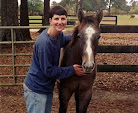
September 3, 2010

Fast Track, Week 1: The Adventure Begins


Right, so I’m here in Colorado and have just completed the first week of my Fast Track course. As I’m too tired to write anything during the week (and really need to go to bed as soon as I get back to the condo anyway), all of my blog posts will be written on the weekend and will be, as my roomie and travel companion Alex would say, epic. Those with great intestinal fortitude, read on.
Week 1 of our adventure was really our journey to Colorado, which took almost a week from the time we left home to having the horses settled at the Parelli Center. The length of the trip had given me great pause when I signed up for the course, but it turned out to be much easier than I had imagined possible, in large part because Lupin and I both had excellent travel companions. 28 hours on the road by myself with a horse to worry about would have been tedious if not downright harrowing, but with Alex and Indy along, it was actually kind of fun. They’re both easy-going spirits whose company it would be difficult not to enjoy, and Alex and I were able to stay onsite with the horses every night on the road, which made things much less stressful.
So with nothing much to report from our trip, we’ll move on to the course itself.
Day 1
Monday morning we got up at 6:30 in order to have the horses, who were boarded down the road for the weekend, to the Parelli Center by 8. As we hadn’t spent much time on trailer loading beyond what was absolutely necessary on the road, we took a little time loading both boys before we left—an activity that indicated we might have had a little slippage in that area over the course of the trip. But we got a little improvement, got them loaded up, and headed for the Parelli Center.
Check-in was uneventful despite the mostly rainy, slightly chilly weather (rain in Colorado is more like Irish rain than Southern US rain: an intermittent, mostly light downfall that doesn’t impede activity). We were assigned pen numbers for our horses and off-loaded our stuff into corresponding locations in the tack cabins, feed containers, and cubby holes in the lodge. (Lupin’s pen is at the top of a hill, so that I get plenty of exercise carrying blankets and water buckets and pushing wheelbarrows up and down the hill. The appropriate response to such a situation in Parelli land is: “Oh boy! I get to build some extra physical stamina!”)
After we had our horses and stuff somewhat sorted out, we met in the lodge for orientation, and I was quite impressed with the talk that John Baar gave. I will confess that I had heard some things about the Fast Track course that concerned me a little: about how we would spend the first 3 days being tested, and about how they don’t really teach you the way instructors do in a clinic, instead leaving the students to work mostly on their own. I worried for months that the testing would make me feel the need to prove myself at the expense of my relationship with Lupin, thus getting our month off to a horrible start and clicking me into hyper student role instead of caring partner role. It also seemed like if we were mostly left on our own to do things . . . well, I could just stay home and do that.
Horsemanship Principle #2: Don’t make or teach assumptions.
John explained the rationale for the testing—that in Pat’s dream course, the teacher gives the students the final exam on the first day of class so that they know exactly what they’ll be graded on at the end. He assured us that he wasn’t going to test us on anything he wouldn’t subsequently teach us. And he told us to trust the process, even when we don’t understand it—a thing that is sometimes hard to do at home, but that seems so much easier when you’re actually on the Parelli ranch surrounded by so many positive people. I found it surprisingly easy that Monday to let go of all my concerns about how the course would be run and just go with the philosophy that it all would work out well.
John also talked about the need for us to take responsibility for our own learning by being proactive when we need help, which I’ve heard before, but I liked that he added we need to take responsibility for our own attitudes. He said that you can choose to be a victim and complain about the things that are done to you, or you can choose to be proactive and make things happen for you. I like the correlation between this and the way that Parelli teaches us to do things with and for our horses rather than to them. (For an apropos aside, visit complaintfreeworld.org.)
As we moved into the afternoon and the written theory test, I was just happy that the horses got a day to settle in and chill and that all the testing for the day would be without the horses. That took away the chance of my doing anything negative with Lupin as a result of my own stress, which in turn took away most of the stress. By the time we moved outside to do our tool tests, I was actually having a lot of fun. All of the remaining testing involved different stations, with all of us numbering off so that we’d be evenly distributed but moving individually from location to location. We were given maps with numbered locations, so it became almost like a treasure hunt, and I had no great illusions about my tool savvy, so I was able to just have a good time with it. We have about 50 people in the class, almost half from Europe & New Zealand, so it was also fun to pass them going from task to task and learn a little about them.
In the evening we were free to get our horses out and spend some time with them. Lupin was, of course, a little up, but being an introvert, his “up” is rarely extreme. This is perhaps a bad thing, because it makes it easy for me to avoid dealing with the fact that I don’t have his full attention. Alex said she has to get Indy’s full attention because, as an extrovert, he can get quite dangerous if she doesn’t have it, but I can always choose the lazy route with Lupin, though sometimes there is a price.
By the end of the day Monday, my tiredness created both laziness and bad judgment in me. I should have just let him walk around, asking nothing. But there were some obstacles, so we played a little bit, and one obstacle was a trailer. I wanted to follow up on our trailer loading session of the morning, and I’d also heard we’d be tested on trailer loading the next day, so I couldn’t resist doing a little prep. But I didn’t set it up very well, and it was getting dark, and I couldn’t really tell whether Lupin was unconfident or just testing me when he refused to go in the trailer.
I’ve been working on myself to ask more out of him because I tend to ask too little, so I defaulted to being fairly strong with him, and he started to pitch a fit, trying to come over the top of me and kicking out at my stick and string. I, in turn, got even stronger with him because I don’t want him to think he can intimidate me. I don't say this was the wrong response, but it didn't do much for our relationship, particularly as we had to quit without reaching much of a good stopping place because it got dark while he was still emotional. In the end the only thing I could say that was purely positive was that I hadn’t gotten emotional--which, given Lupin's level of emotion, was pretty impressive. I may have been stronger with him than I needed to be, but I hadn’t done it out of anger or fear. So I called that one little thing a win, and I made the promise to myself and to him that that was it: I absolutely would not do anything else over the next few days that would put our testing before our relationship.
That promise made Day 2 and Day 3 infinitely better, but as it is now infinitely later than I should stay up, even on a weekend, my narrative of those two days will have to wait.

August 12, 2010

Taking it to the trail

One thing about cramming for my Parelli course is that it’s easy to get distracted from actually keeping my horse fit. I mean, I’ve been riding him every day, which is a deal more than he usually gets, but we’ve been spending the majority of each day in the ring and at the trot. Polocrosse practices got us briefly doing more cantering in the field, but those are on hold right now and Lupin has been starting to lose some of the fitness he’d developed there.

So I decided to make a concerted effort to get out and about at higher speeds. Today we did a fairly hilly and long trail after having done a shorter version of it two days ago. Although we had some initial disagreement about Lupin’s level of motivation for hitting the trails, we used the savvy Dan taught me for this—let him turn around if he wants, then ask him to keep turning until he’s faced back the direction I want to go. Repeat as necessary. This strategy is excellent because it doesn’t set me up to get in a fight with him, as I had been doing before. Instead, I go with his idea and ask him to keep going with that idea. So although he continues to test me periodically, it is now a non-issue to deal with it, and he eventually goes, “Oh alright then. Let’s go.”

And usually we have a few rounds of that somewhere, and then he’s okay with going adventuring. Today was no exception, and we got most of the way around the loop before we had any other challenges to deal with. Then we encountered the inevitable: a fallen pine tree blocking the trail. We’re quite used to blazing our own detours, but this one was tricky: banks almost straight up and down on either side of us. I didn’t want to go all the way back around, though, because doing so would functionally double the length of our ride.

I tried moving the tree to no avail. I looked at the down-side bank: no way. I looked at the up-side one: okay, a little tricky going up, but it looked better coming down on the far side of the tree. So I decided to go for it. But I decided to go for it off of my horse.

The bank was probably about 8 feet tall and slippery with sand, and I couldn’t have gotten up it myself without the fallen tree to hold on to. Lupin tried to come up behind me, but he couldn’t go slowly up the bank without sliding back down and I was in his way the first time he tried. But I had just enough rope to be able to get to the top myself and then ask him.

He barreled up with enough momentum to get purchase above the bank the second time. At that point, we were committed to my decision. At that point, though, Lupin had also gone a little right brain, and he started beating his own trail through the trees in the wrong direction. I had to do some hard work to get both back in front of him and above him on the slope (as I didn’t want him to slide down it onto me); then we began the process of backing him out of the spot he’d gotten himself stuck in.

Finally all turned around, we made our perilous way around the tree, only to discover that the bank I’d optimistically thought was easier wasn’t: it was still about an 8’ drop down a sandy slope that gave way under foot. At that point, I decided that Lupin and I were something of a liability to each other if we stayed attached, so I dallied his reins up and left him to decide whether to follow me as I tried to beat through a bramble to a better descent or whether to go for it.

I’m not sure whether he decided to go for it or whether the bank gave way beneath him, but he went careening down the bank, landed on the trail, and just managed to apply the brakes before he went over the other side of it and down the next bank. He bucked a little then and looked fairly perturbed, but as I held my breath from the bank above, he did not go galloping off down the trail, for which I was very grateful, as there was still a good climb and then a long walk back to the barn. He also had kept his feet the whole way, and I’ll say this for Thoroughbreds: they may be frail, but they’re also terribly athletic. Which, all things considered, may be a necessary trait for the horses I own.

As I slid behind my leading foot down the bank to join him, I had a feeling familiar to me from our previous years together of successfully overcoming a challenge with my capable partner. There was a time when I had utter confidence in Lupin’s bravery and abilities, and he seemed to have much the same in mine. It’s possible that we were just both equally deceived in each other—certainly my judgment, anyway, might be a bit suspect after the day’s detour scheme. But while Lupin would have been reasonably well within his rights, I think, to have said a big F U to me and cantered off, he remained with me instead. Maybe he was just still standing there in shock that I’d asked him to do anything so ridiculous. But I’m going to hope, for now, that he stood there and waited because my partner has returned and is ready for further adventures.

August 10, 2010

And, in short, I was afraid.

It was almost exactly a year ago that I signed up for the course I’ll be taking in September, and at that point I was up to my eyeballs in the self-assessment lists I’d been required to fill out for my application. Parelli believes in progress, and he likes to give you lots of tasks that you can use to gauge your progress, test your relationship, and motivate yourself to move onto the next level. I remember talking to the gal handling registration for the course, who looked over my paperwork and said that, if I had been planning to take the course soon, she wouldn’t have recommended it for me, but since I had a year to get ready, she thought it would work fine.

So I set off with my list of holes I needed to plug in: leading Lupin backwards by the tail, 6-10 laps at the canter in our circling game, all 4 feet on a pedestal, and on and on. But what was increasingly concerning me was the resistance I was finding in Lupin to things he could already do. The horse that had once run in from the pasture beside me with no halter on was violently breaking away from me and galloping off when I tried to lead him in. The horse that had been much admired for his willingness to trailer load at our course in Florida was refusing to let me close the gate, and often refusing to load altogether. The horse that had trotted off gamely down almost any trail for years was suddenly turning around and refusing to go further.

And the horse that had felt like a perfect partner just a year or two before now felt, as often as not, like an antagonist with malicious intent.

The yearly clinic that had happened in our area was no longer available, so I looked for an instructor nearby and found Dan Thompson in Georgia. By the time I went to my first clinic with Dan, I had lost any idea of how to deal with my horse. Technically, we could still do lots of cool things, but emotionally I never knew where we would be. I almost started crying when I first introduced us and began to describe what was going on. And I spent the rest of the clinic either on the verge of tears or actually in tears.

It wasn’t that the clinic was horrible. To the contrary, it was populated almost exclusively with really cool people who had problems very similar to mine—it was a clinic filled with mischievous left-brained horses that had begun to get the upper hand on their owners. And Dan did an excellent job of keeping things fun so that we all kept a sense of humor. But I was nonetheless forced to come face to face with the fact that I had become afraid of my horse.

I’ve rarely found anything to fear in horses—unless they have extreme emotional problems that cause them to be highly dangerous. And I’ve certainly never been scared of my own horses. The pony I had as a kid was, to be sure, a holy terror, but I just kept getting back on, figuring that’s the way it was. I’d had more spills than I could count off of Lupin’s mother, but she’d had a heart of gold and it never even occurred to me to be scared of anything she might do. And I had built my entire relationship with Lupin on tackling things that had been scary to Limerick: dump trucks, new places—anything that bothered him I made a point of seeking out.

But what nonetheless became clear to me during the clinic was that, bit by bit, I had lost my trust in my horse and my faith in myself. This had happened, it turned out, because Lupin, being the kind of horse who tests things, had repeatedly tested me, often finding a lack of knowledge here, a disinclination to be particular there. And I had responded, without knowing it, by just backing down—sometimes only in my body language without my mind ever knowing I was doing it—or by avoiding certain things. So while I had pushed Lupin’s tolerance about environmental stimuli, I had done nothing to develop his tolerance for having to do things he didn’t want to do.

The most obvious example of this was tying. I had thought I had taught Lupin to tie as a youngster, but then he went through a period of breaking free. I didn’t really know how to fix this, so I just left it alone until later. But that was no doubt the seed of his later revolts when he would break away from me coming in from the pasture: in both cases, the porcupine game (yielding to steady pressure) was broken. So was our relationship, because he knew that I had backed off rather than pushing him, so he lost respect in me.

Dan agreed to work with Lupin on tying over lunch, and if up to that point I had only suspected that I’d become afraid of Lupin, I learned beyond a shadow of a doubt that I was scared then as he reared and jumped violently around, displaying not just fear, but also anger. I knew I didn’t have it in me to do what Dan had done. I just didn’t have the knowledge and timing—not to mention the emotional collection—to pull it off at the stage I was at. But Dan had done the hard part, and he’d given me the key I would need: it was all about my own attitude. If I began to insist on things with Lupin—politely, but nonetheless firmly—everything would start to get better.

And that has proven, over the last year, to be the case. I never had to work with Lupin on leading in from the pasture per se, because my attitude changed across the board and so did our relationship. I did have to go back to Dan for help with some of our other problems, but always the answer has been the same: firmly but politely push him a little beyond his comfort zone until he learns greater tolerance, then push him further. Once Lupin learned that this was going to be my consistent plan, he settled down and the temper tantrums have all but disappeared. And, equally importantly, we've both started to have fun again.

This is, after all, a horse who has strong opinions, but one who also fundamentally likes to learn new things. When I teach him a new pattern in the ring and then do a passenger lesson the next day with my eyes closed, I open them to find that he is, on his own initiative, going over cavaletti or squeezing between barrels. He wants more than anything, I think, a human who will be a gateway to new things but who will give him the leadership he needs when those things overwhelm him. In short, if I can just be the human he needs me to be, he can be the perfect horse again. Partnerships do, after all, work two ways.

At our most recent clinic, which was a trail clinic, pushing boundaries became an excuse just to plain have fun. Whacking branches with our sticks, doing packstring-long yo-yo games on the trail, asking our horses to go away from the group to circle trees, etc.—we took all the things that make both humans and horses right-brained on the trail and made them into games instead. Which is what Parelli is all about at the end of the day: developing the knowledge and the confidence to transform things that once created fear into things that create playfulness.

And while we ate lunch on the trail and discussed the morning's activities, Lupin stood quietly tied with no indication that it bothered him in the slightest.

***

I haven’t gone back and looked at those self-assessment lists in preparation for my course. I may not be to the point where Lupin can canter 6 laps on the circle. But I do know how to laugh about it instead of freaking out if he breaks away from me when I ask him to, and I know that, with enough knowledge on my part, I can turn it into a game that he’ll enjoy playing enough to want to canter for 6 laps. Most importantly, I know that we can ultimately do anything we put our minds to because we now have our fundamental relationship restored. And that’s a lot more important to me as I head to Colorado than any list of specific tasks that we could have accomplished this year.

June 5, 2010

The Power of Positive Feedback

Having been much in the company recently of someone who not only gives genuine positive feedback in abundance but also inspires other people to do likewise, I’m left to wonder why this isn’t a more common practice. Pat Parelli says that humans and dogs are motivated by praise, recognition, and material objects. Yet although two of those three have a huge effect on the receiver with little cost to the giver, they are not often in evidence. Why?

In part, I think that, for Type A personalities especially, it’s so much more a habit to focus on what still needs to be done instead of what has been accomplished. It’s also a constant challenge, as Parelli acknowledges, to “be particular without being critical.” But what a difference it makes when you can manage it! It's the key to so much--even to horses, who are not themselves silly enough to care much for such abstractions as praise and recognition. They do care, though, that you don't just keep hounding them in your quest for perfection (which they are also intelligent enough not to care about), and they certainly get that their lives have more of what they *do* care about (comfort and play) when their human is less critical.

For me, I can weigh how much power positive feedback has by the fact that I remember just about every instance of it that I have gotten during my training of Lupin in the past 9 years. Of course, my sensitivity to it was heightened early on by the fact that, before Lupin, I had never raised a horse from a foal, and I was completely paranoid that I was going to do something wrong and screw him up for life, with the possibility of dire consequences for both him and myself.

And then there’s the fact that having a small foal is a lot like being pregnant: everybody has a strong (and often different) idea about what you should be doing and how you should be doing it, and they’re more than happy to share. When you’re a little uncertain yourself (as I very much was since I was brand new to Parelli as well as to colt starting), it’s overwhelming.

So the instances in which an outsider just said to me, “Marian, you’ve done a really good job with him,” stand out like little oases in a vast desert of uncertainty and doubt about what I was doing. They were moments that allowed both Lupin and me to breathe a sigh of relief because, for a space, I took the pressure off him and just relaxed.

Parelli’s goal is for his students to be positive, progressive, and natural while using love, language, and leadership with their horses. None of this has come easily for me with Lupin. When he challenges my leadership, it’s difficult for me to hold on to the love, and all the abilities that love gives you: patience, and forgiveness, and strength. Learning the natural language of horses is a humbling experience that makes you realize how very little you know about horses, whether you’ve spent a lifetime with them or not, and being truly progressive requires a level of creativity and flexibility that I don’t even begin to have, but that I am beginning to work toward.

But for now, being positive begins to seem like the thing on which all the others hinge. It is the fulcrum on which to balance on one side the quest for excellence, which you can’t pursue without a positive goal, and on the other, the ability to appreciate what you and your horse have already achieved--without which you will never be able to genuinely acknowledge your horse’s “try’s.”

May 31, 2010

So it begins

I have had the idea to write about my relationship with Lupin ever since he was born, as I knew that my first time raising a colt was bound to be an experience filled with the kind of personal growth that can always be converted into good narrative value. But I’m a born procrastinator, and so it took me 8 years to seriously start thinking about what I might write.

At that point (which was last summer), I hatched the hare-brained scheme to take Lupin to Colorado for a month-long course at the Parelli Center. Colorado, note, rather than Florida (which is days closer) and a course that is essentially designed for Level 3/4 students while Lupin and I are still happily plugging away in Level 2. Yep. That seemed like good narrative potential for sure.

But did I mention that I’m a procrastinator? While “My Year of Not Getting Ready to be Totally Overwhelmed at the Parelli Center” would have been a catchy idea for a blog . . . well, somehow it didn’t happen. So now we’re more like into “My Last Few Months of Cramming for my Parelli Course, Most of Which I’ll Spend Writing this Blog Instead.”

So as not to waste further time, I’ll just quickly introduce us. Lupin and I both have playfulness and stubbornness as key personality traits. We are, I strongly believe, perfect partners for each other—or at least the kind of partners that we each mutually deserve to have. But the problem is that I am more playful in virtually every area of my life than I am with my horse, who is the one being that would most appreciate it. He deals with that situation by creating his own games to play with me, which always seem to highlight my areas of greatest inadequacy. And feelings of inadequacy do not readily lend themselves to a sense of carefree playfulness. And so the downward spiral begins.

On the stubbornness front, however, I still feel pretty competitive. After all, I’m still here. But Lupin likes to give me a run for my money there too. Pushing my emotional buttons is, in fact, one of his favorite games, just as I myself have been known to push other people’s buttons for my own amusement. It is possible that Lupin would have been more aptly named if I had called him “Karma.”

Despite all of this, however, I see glimpses now and then of something more than Lupin and me battling it out or, on our less inspired days, poking around in half-assed apathy. Every once in a while, Lupin really does feel like my partner—a partner in crime, or at least in happy chaos, and a steadfast being there to back me up when I don’t quite come through. And it’s for that reason, more than any other, that I stick with Parelli: because I want to see where Lupin and I could go together.

For non-Parelli folks, Parelli is both a person and the horse-training system founded by Pat Parelli—though it’s actually human-training that Parelli does. Parelli operates on the assumption that it is almost always the human, rather than the horse, that needs to learn more, and what humans need to learn is more horse savvy. Students study in four areas:

1. On Line: on the ground with a halter and different lengths of line on the horse

2. Liberty: on the ground with nothing on the horse

3. Freestyle: mounted with the focus being to use only your focus—your eyes—to guide your horse

4. Finesse: mounted with a high level of precise movement achieved through reins, etc. (similar to dressage)

Parelli calls itself a journey, and it is. It’s a journey of self-discovery and self-mastery, and also of relationships and leadership. The principles apply across all areas of life, but horses make them more immediate, and more real, since horses are nothing if not honest, and also big enough that you can’t ignore the potentially disastrous consequences of bad decision-making.

For all of these reasons, I tend to wax analytical when I’m on the topic of my horse. Once more, playfulness loses out. Perhaps by the end of the blog, I will have achieved more of a balance there. For now, those intrepid souls who choose to continue reading this blog can expect a rather bland mix of pop-psychology, self-analysis, and general rambling, peppered, one can only hope, with the occasional interesting anecdote.