I have spent the past week participating in the first half of a 10-day course with Mark Rashid and Crissi McDonald. For this course all the riders have been borrowing horses that live here at Happy Dog Ranch.
For the first few days we practiced aikido in the mornings and rode in
the afternoons. But on the fourth morning we were getting ready to ride
both morning and afternoon.
As we had our post-breakfast meeting
before heading to the barn, one of the women in our course said that
she was a bit dreading riding twice that day. She said she'd been
feeling guilty all week because her horse didn't seem to enjoy being
ridden and now she was feeling even more guilty to ask the horse to go
out with her twice in one day.
When Mark asked her why she
thought the horse didn't want to be ridden, she cited the horse's
unwillingness to be haltered in the paddock, resistance to the bit being
put in, and refusal to stand by the mounting block. She added that she
had encountered these issues with some of her own horses and had been
unable to continue riding them because she couldn't enjoy riding if the
horse seemed unhappy about being ridden.
I wish that I had an
exact record of what Mark said in response because it profoundly changed
my perspective. But here at least is what I remember.
First and most importantly Mark said that we don't know the horse doesn't want to be ridden.
Just that one statement changed the whole conversation.
We tend to get a bit lost in our own stories about what is going on.
But as Mark went on to say, all we really know for sure is that the
horse has certain behaviors (like putting her head in the air when the
bit is offered).
It may be that the horse was handled roughly at
some point in her past and developed these patterns of behavior as a
defensive response. Our job, however, is neither to suss out the horse's
past history nor to figure out what her present behavior might "mean."
It is simply to help her do the things that we are asking in a way that
feels better to her.
We don't achieve this by backing off when
she seems resistant to something. Nothing changes that way. We achieve
it by having a clear idea of how we would like the thing to feel both to
the horse and to the human and then staying with it until she finds
that feel.
Ultimately yes, we require our horses to do things
that they might not choose to do. However we also have the opportunity
to help them find softness and relaxation by finding those things first
in ourselves and then offering them to our horses. And if they then tap
into their own softness and relaxation, we can be fairly confident that,
whether they would have chosen to do that thing or not, they are no
longer bothered by doing it. They might even be happy about doing it.
In short, we have to believe that we can be agents of change in our
horses' lives--that we can be a positive force to help them rather than
just something they put up with because they have no choice.
And
this belief carries over to the whole of life. What if we work from a
space of assuming that we are making a positive impact? What if we keep
in the front of our minds the joy that we have to offer others? What if
we look at the sky at the end of the day and say, "It was a good day. It
started out good, and then I was able to make a couple of things a
little better," and then we enjoy some dinner and go to bed?
August 14, 2016

March 24, 2016
Why Doing It Right Is So Wrong
I took a workshop in Masterson Method
bodywork for horses last weekend, and there was SO MUCH GOOD. For one thing, it
was a privilege to work with the Thoroughbreds we learned with, who were so
willing and who showed so much improvement in their musculature and their
relaxation after just one day. It felt great to be doing that kind of good for
horses in need of it.
But by far the most good done was the good
done to me.
The Masterson Method can have the positive
effect that it does, I believe, because it creates a space where there is no
wrong.
The horse can do no wrong because everything
he does is just part of his process of moving from defending himself to letting
go. Whether he chews on things or fidgets and moves around or seems to be
completely ignoring you, all of that truly is just information by which you get
an idea of where he is in the process of letting go—not a behavior that needs
correcting.
And the human can do no wrong because the
Masterson Method can only do good for the horse. Even if you’re only “in the
neighborhood” of where you’re supposed to be, you can help the horse release.
Even if you don’t wait for the release, you’ve helped the horse to start
processing. Even if you can’t do all the techniques perfectly, you can do a
great deal of good.
This is a radically freeing space in which
to exist. By contrast, how often do we feel that we are screwing things up or
aren’t good enough to perform in some way? That we don’t know enough, don’t have
the skills or the discernment? And how often does the need to be and do things
right leave us isolated in our own heads instead of connecting with others?
The amazingly cool result of being in the
space of doing no wrong is that you can listen phenomenally well. When your
ego-driven need to do things right isn’t running the show, you can suddenly
hear all sorts of things your horse is telling you. And the amazingly cool
result of THAT is you find yourself truly working with the horse.
In fact, that’s what the Masterson Method
is: a process the horse and human go through together, each guiding the other
in an endless back and forth of offering and receiving suggestions. It
absolutely defines doing things *with* the horse.
Of course many of the people I’ve studied
with have emphasized the need to do things with and for the horse rather than
to or at him. And I’ve agreed every time. But actually living in that space has
been hard for me to do. I may in general have a goal of, say, helping my horse
overcome his fear, but when I ask him to do things to build his confidence, I
find myself stuck in my own agenda of asking him to confront his fears instead
of in a conversation with him about how best I can help him feel better.
So my experience last weekend was almost
wholly novel to me. I saw that the horses were just where they were, doing the
best they could to manage in the lives they’d been handed. I saw that they were
going to struggle some with the process of letting go of their defenses just as
I was going to struggle some with the process of learning how to help them do
that. And I saw how willing they were to go through the process with me despite
all of that.
All of this made me feel great compassion
for everyone, animal and human and myself included, who has built defensive
patterns to keep themselves safe and yet yearns to let go of those patterns. As
our instructor said, a horse saying, “No, no, no, no,” is really saying, “Help me,
help me, help me!” True for horses, true for people.
And in this context, worrying about doing it
right just doesn’t even factor in.
January 29, 2016
Peace
Before I left for Florida I had come to the
conclusion that peace--your own internal sense of being calmly centered--is the
most precious thing you can offer to someone you love.
In Florida I began to see that it’s even
deeper than that: peace isn’t a gift you give so much as it is the environment
necessary for love to truly flourish. Without peace, love just doesn’t come
through the same way.
I have loved Lupin his entire life. That
love has kept me with him through times I felt like there was no way we were
going to work things out between us, through times I felt overwhelmed by
everything I didn’t know about how to help him, through fear that both of us
would get hurt. I’m a stubborn person, but I don’t think you can be that
stubborn over that long a time without love lying at the root of it.
At the same time, though, I have rarely felt
like that love really came through to Lupin very clearly. In a certain way we
were pretty strongly connected, but not in a way that often felt great to either
of us. For my part I was always cranked about all the things I didn’t know yet,
about not doing it right, about screwing up my horse. Lupin was more often than
not only half engaged and pretty quick to shut down. I’m not confident that
either of us were truly keen on spending time together. But I kept at it,
because I love him.
And I’m not belittling that kind of
commitment. Sometimes that’s what love is: working hard and gutting it out for
someone you care about.
But I also think we make love into this far
more often than we need to. We have this immense amount of love for someone,
but only a tiny bit of it manages to trickle through the wall of tension that
we’ve built around it. Tension created by the fear that we’re not good enough,
or worry about what will happen, or stressing over what the other person/animal
thinks or feels, or focusing on things that we perceive to be problems in the
relationship.
I think it’s a lot like what Mark says about
physical power: our power is far greater than our actual muscular strength, but
power doesn’t come through if we are tense. We need to be soft internally for
our power to be anything close to fully effective.
To me it’s the same relationship between
love and peace. We can have vast amounts of love, but if we aren’t peaceful, it
just doesn’t come through.
The best part about my time in Florida was
that everything was peaceful. Learning was peaceful, connection to my horse was
peaceful, being in general was peaceful. Not only do Mark and Crissi foster
this kind of atmosphere; they teach their students how to cultivate the peace
that’s within themselves in the form of softness, calmness, and staying
centered.
The first day I spent in Florida I lay in
the sunshine enjoying how good it felt on my skin and how beautiful Lupin
looked in it. As the two weeks went along, it felt more like that sunshine was
inside me, inside Lupin, and connecting the two of us together in a soft,
relaxed, golden feeling that I can only describe as deeply peaceful love.
January 22, 2016
Getting to the Goal
I realized as I was packing up to leave for
Florida that I was scarcely even thinking about my Florida trip beyond its
logistics. In fact, despite knowing that my trip would be wonderful on many
levels, I was thinking right on past it to when I got back. Because then I
would be done.
I’ve discovered a similar tendency in my
horsemanship and in most of the things I do. I’ll call it the exam mentality:
that looking forward to when the thing that you’re about to do is in the past
tense.
It’s a habit that has been exacerbated when
it comes to horse stuff by some of my past learning--in particular the idea
that the moment the horse does what you want you take all pressure off and
quit. That technique, designed to give the horse a clear reward when he does
what you ask, has the side effect of causing both you and the horse to look
toward the moment of being finished as the happy place. In short, you both
celebrate the moment when you can be done with doing things together. Not
exactly a recipe for enhancing your sense of connection.
Mark has been pointing out time and again to
me that it’s counter-productive to quit just when everything is feeling good.
You and the horse both just made an effort to get things going well: why would
you just drop it the moment you do?
Yet the only area of my life I can think of
where I don’t do just exactly that is dancing. I don’t dance to get to the end
of the dance: I dance for the joy of dancing itself. In every other area,
though, I am looking for the end/result/stopping place/point of achievement.
And that is generally true of positive things as well as stressful things.
I’m not sure exactly how this mentality
emerged. Maybe it has to do with lack of confidence, an intolerance for
existing in a space of uncertainty, an assumption that effort is negative, or a
need to check things off a list to feel successful. But however it came about,
I have no doubt that it is just that: a mental pattern, a mindset that can be
changed.
And what I’m discovering this week is that
how you change it is to focus on feel rather than result. It’s a beautiful
thing for my horse to float softly sideways when I just think sideways, but if
I’m just admiring the accomplishment, I am losing almost all of my connection
with my horse, and with joy, and really with the whole point of doing any of
this.
Joy lies in feel. It lies in feeling your
own insides hum in harmony with your horse’s insides, in the feeling of
relaxation in both of you, and in the lightness of existing in the realm of
softly doing rather than the realm of thinking.
Until now the only way I have found peace is
in not doing. For the first time this week I’m starting to feel how there can
be peace in doing. How doing things without a physical or mental brace lets you
be light even in the midst of effort, and how doing things for the feel in the
present can erase the weight of needing to achieve.
And I’m discovering that true peace does not
come from having done. You may find relief from having done, but peace comes
from finding joy in the doing, and living in that joy. That’s the realm we are
meant to live in. Not a state of mere satisfaction with our achievement, but a
state of active joy in living itself.
December 14, 2015
Softness Is Always the Answer
One of the things that most appeals to me
about the art of Aikido is that it develops the ability to soften even – in
fact, especially – when under attack. Softness disarms your enemy internally:
it melts the brace that is inside him. And even if it doesn’t achieve this, it
gives you some space to work because you are more fluid, and it allows you to
be more powerful because you can use your energy more effectively when you’re not tense.
Until I learned about all of this, life
seemed divided into two areas to me: times when you could be soft and peaceful,
and times when peace wasn’t going to cut it and you had to fight.
The idea that softness is the answer even in
the most extreme and threatening situation was a game changer for me. If
softness is the best answer when your life is at risk, then what reason can
there possibly be for anything other than softness the rest of the time?
I guess I should be clear that being soft
doesn’t mean being a pool of jello on the floor. It means that you are not
tensed – in body, spirit, or mind – against what is happening.
Acceptance, releasing tension, and breathing
are all components of softness, but it’s so much more than that. Most
importantly, it is an attitude of opening yourself to others, looking for
openings and opportunities to blend with others, and using joyful energy
instead of strength.
Softness is dancing with life.
Generally I am predisposed to be tensed
against life. If I feel bad physically, I tense against it, achieving nothing
except escalating and prolonging the pain. If I feel tension in those around
me, I tense in response, upping the tension one more level. If things aren’t
going the way I want, I brace against them, trying to regain control, instead
of flowing with them to find a new opening (which I can’t see because of my
control-induced tunnel vision).
Now, however, I don’t just believe that
softness is always the answer; I know it. I also know that softness is a
practice – a practice of embodying that belief every day, of translating it
into a physical reality inside yourself. It’s an alchemy waiting to happen in
every moment that I choose to practice it.
I am far from mastering this practice, but
now at least I know that life is divided, not into when softness is appropriate
and when it's not, but merely into this: when I am practicing softness, and
when I am not.
November 4, 2015
To Thine Own Self Be True
This past January (was it really only this
past January??) my horse guru Mark Rashid shook my world a bit
with his very simple advice: do what feels good.
Mark wasn’t advocating hedonism or following
your bliss or any of that sort of thing. He merely proferred the suggestion
that if we do what genuinely feels good inside us, it will probably feel good
to others, and then look, there’s a whole bunch of us feeling good together.
A radical notion. Especially for one with a
life-long habit of doing things the hard way, complicating things
unnecessarily, stubbornly clinging to her own clearly ineffective methods, and
thinking—rather than feeling—her way through life.
In the intervening months I’ve gotten a lot
better at following the path that feels good. And I’ve generally found that
when I do that, I’m still going where I both need and want to go—I just get
there with a lot less drama, agonizing, analyzing, and head banging than I used
to. And way less second-guessing and obsessing.
I’ve noticed, too, that how I feel gives me
a lot of helpful advice about where I want to go. I used to think that feelings
were just things that got in the way of where I wanted to go and that I should
be able to tamp them down and carry on. Now I get that my feelings are probably
much more valuable as information than my thoughts.
For instance, I’ve been to horse clinics
with three different teachers this year. I enjoyed and learned something from
each teacher. All of them were very engaging and had an interesting perspective
to share. But when I started thinking about how I *felt* after each clinic, the
difference was staggering.
After Mark’s clinics I felt calm and clear
and as if the path in front of me was a simple and happy one. Perhaps not
entirely easy, not without some difficult moments, but still peaceful in the
way that moving forward in harmony with who you are gives you peace.
After the other two I felt excited at the
hope that there might be a better answer out there than what I had found so
far, but I also felt fairly cranked up about all the things I had been doing
wrong, all the things I felt I had failed at. And even my successes in those
clinics didn’t feel right to me, despite the fact that they got results. I
didn’t realize this, though, until I stopped thinking about the ideas at the
clinics (which sounded very good) and started thinking about how I felt as I
responded to them.
I want to be clear that I’m not saying this
to dis anyone in any way. I say this because it’s a fairly radical notion to me
that my mental and emotional state tells me something about the influences
around me rather than just being something that I need to sort out, dammit, so
I can get on with what I’m trying to do.
I react differently to different people and
different ideas, and that’s not a judgment on them or on me. What it is is
information about the best way forward for me—the opening that I can move
through with softness and peace, hopefully bringing that softness and peace to
others as I go.
August 19, 2015
Finding an Opening
When I first met Mark Rashid
a year and a half ago, he talked about creating openings. He said that horses
are like water and will flow through whatever openings we create.
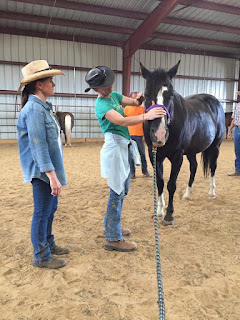
This image really struck me because of
the beauty, ease, grace, and peace of it. I had gotten used to having fights
with my horse, and I had been assuming that he wanted, not necessarily to have
those fights, but at least to resist what I was asking. It was beyond refreshing
to consider that there was an entirely different way and that, if I gave him
the opportunity, my horse could be an entirely different (and happier) horse.
One hugely wonderful part of my 10-day
course was learning more about openings. In the dojo, I learned not only to
soften myself from the inside, but to allow a connection to happen that in turn
allowed my partner and myself to move together with our insides connected.
Opening myself like this became the first step, always, for finding and
creating openings with the horses.

The Masterson Method work, geared
toward helping the horse release tension and allow his joints to be moved
freely in a state of relaxation, then taught me how to look for openings in the
horse. I learned to feel for where the horse *could* relax and to start there,
instead of focusing on the area that I felt he needed to relax or on the
technique that I was trying to do. Any place the horse was able to relax was
the opening to creating more relaxation.

And this idea carried through to the
riding too. If we focus on what the horse can't/won't/doesn't want to do, that
generally means that we're focused on where the brace is, which means that
movement is difficult and, if it does happen, filled with tension.
But if we focus on where the horse is
already moving with ease, we can go through that opening together with him and
build from there. That may mean turning left instead of right, or walking
instead of trotting, or backing up instead of going forward. But what it means
above all is being truly dedicated to listening to what the horse is telling us
feels okay and blending with and building on that instead of pursuing our own
agenda of what we think he should do.
This doesn't mean that we do whatever
the horse wants. But it does mean that we let him tell us how we can get where
we're trying to go instead of just pushing him into it.
The moment this really became clear for
me was when I was working with Comet on backing. Comet tended to put his head
down and brace defensively against going backward. Mark showed me how to lift
his head to where he didn't have a brace and ask for a soft backwards from
there, rather than continuing to focus on backing from the point where he was
braced. And then Comet and I moved easily and beautifully backward.
Maybe if we want our horses to move
like water, we need to be willing to have a little of the ability to flow to
where there's an opening ourselves.
* * *
On the last day I realized that looking
for openings is my own opening to a better perspective. I tend to focus on what
needs fixing, what still needs work, what we can't yet do. In short, I see only
the negatives. And it's all well and good to say something like, "Focus on
helping the horse relax," but it takes my critical brain only a nanosecond
to turn that into, "My horse isn't relaxed!" And then we're right
back to focusing on the negative.
If I am looking for openings, however,
I don't have room to see negatives. If it isn't an opening, then I am simply
moving on to what is one. There's no point in making judgments because I'm not
interested in judging: I'm interested in finding.
And it's pretty amazing what you can
find when you're not wrapped up in focusing on what isn't working. Among other
things, Comet and I found a little bit of harmony and joy. And *that* is
something worth building on.


Subscribe to:
Posts (Atom)