September 11, 2013
On loving a left brain introvert — and why it can be hard
"Horses and humans have very similar emotions, but I think why they have them is very different. Horses are quite simple: they are pretty much driven by fear or dominance. They can get confused, frustrated, fearful, anxious, angry, maybe even sad or unhappy, but the reasons are very black and white. It is based pretty much on the moment, and while they can have past memories that drive their behavior today, they do not hold that against humans the way humans can." —Linda Parelli
At one point during my Fast Track course, I was corrected by an instructor when I said that one characteristic of Left Brain Introverts is a tendency to get angry. "Horses don't get angry," she said. "They don't have that emotion." Since then I've heard Linda Parelli talking about horses getting angry multiple times, but I think there's a level on which Linda and my instructor are both right, for, as Linda suggests, horses don't get angry in the way that humans understand the emotion.
What my Fast Track instructor seemed to understand at the time (though I didn't) was the all-too-human tendency to attach lots of meanings to emotions. I believe she wanted me to see my horse without all the baggage that I was attaching to the idea that he was angry, and I've written previously (here) about how liberating that was.
But I think it's important to go a little further now because the fact is that horses—left brain horses, anyway—do get angry (sometimes quite angry), and they can be very dominant, and humans have negative associations with both of these characteristics that impede our ability to empathize with and appreciate our left brain horses. (Not having worked with a Left Brain Extrovert, I will restrict my comments from here on to Left Brain Introverts [LBI's], though I imagine some of this might apply to both).
Humans tend to view dominance as an aggressive, negative thing. We react defensively and judgmentally when others behave in a dominating way, or at the very least we see it as a challenge we need to answer by asserting our own dominance. Anger is even more difficult for us. If someone is angry at us, we tend to take it personally, once again becoming defensive—often by blaming or ridiculing that person—and in the process we become angry ourselves.
When LBI's show anger or dominance, we project a lot of these feelings and motivations onto them, and it tends to trigger our defensiveness and with it our blame, judgmentalism, aggression, etc.
It's interesting because right brain horses might exhibit more extreme emotion and more dangerous behavior than LBI's, but it's much easier for us to learn to accept their behavior. Once we get a little understanding about prey animal psychology, it's clear that when right brain horses are behaving in a dangerous way they are, quite simply, terrified, and once we have some Parelli skills, we can help them safely through that fear. This brings you and your horse closer as partners, and makes you feel like the hero who helped a small, distraught child find her parents. Good feelings for everyone.
But when your horse's unconfidence or intolerance manifests as anger, it feels bad to the human. We take it personally ("how dare he!") and we get defensive: "Look, dude, I may not be the perfect human, but if anyone else had to deal with you, you'd be at the auction already." Good feelings, indeed.
The problem is that, while right brain horses tend to say "I can't," left brain horses more often say "I won't." They may still be simply protecting themselves from what they perceive as a bad situation, but their refusal has a more defiant feel to it. Furthermore, while all horses are honest, LBI's are honest in a particularly ego-shredding way. Right brain horses might show you clearly where your leadership is lacking, but there's a part of them looking at you with eyes that say, "Please figure out how to do this better so we can both be happier." They are, as the Parelli's explain, looking for a leader, and as a result they're much easier to impress. It's almost like they want you to succeed.
Trying to impress an LBI, on the other hand, is like trying to impress your chain-smoking, tough old bird of a grandmother. LBI's don't particularly seem to care whether you get it right or not; they just tell you the truth in a kind of disinterested way, and there's always plenty more truth where that came from. And that's on a mild day.
On an extreme day, when they decide they do care, it comes out in the form of a temper tantrum. At this point your LBI is basically saying to you, "Oh no you didn't just push my button!" And things can proceed to get downright scary for the human—which is, of course, the LBI's intention: for you to be intimidated enough to drop the idea altogether. At these moments, when you feel that your horse is threatening you and you're concerned for your own safety, it is very hard to look at your LBI with love.
But there are a few key things to remember here:
(1) Though a horse having a temper tantrum feels more confrontational and therefore more personal to us than a horse that is simply driven out of its mind by fear, the LBI doesn't want to be in that emotional place of extreme intolerance any more than the right brain horse wants to be panicked. It looks more deliberate, more calculated, and therefore like something they are choosing to do, but they are still being overwhelmed by an emotion that they are not enjoying having. We associate a temper tantrum with bratty children and see it as a manipulative strategy. But even if bratty children are being somewhat calculating, if it's a genuine tantrum they are also the victims of their own excessive emotion and don't know a better way to cope with it. I believe it's the same with horses, and it is therefore just as incumbent on us to help our LBI's learn more tolerance for the sake of their own well-being as it is for us to help right brain horses learn how to be more brave.
(2) A horse pitching a temper tantrum is, still, a prey animal reacting. It is an animal that, having assessed the situation, does not feel that whatever thing is being asked of it is in its best interest. When your horse starts getting punky with you in response to such a situation, it's hard to know exactly what to make of him—it's hard to trust his intentions and to trust him with your well-being. But that is exactly what he is saying to you: "it's hard for me to trust you with my well-being right now." He behaves in a dominant fashion because he is taking responsibility for his own well-being. No, he is not respecting you in that moment, but it isn't personal the way we imagine it to be when other people are what we perceive to be rude or disrespectful. It is simply a fact: I don't respect your leadership skills enough to believe that you will take care of me in this moment and so I am going to take care of myself. (Side note: in humansville this is called being responsible for yourself and is generally seen as a good thing.)
(3) Finally, whether they are people or horses, LBI's are not warm and fuzzy. Their area of specialty is most definitely not blowing sunshine up people's asses to make them feel good about themselves. They are often, in fact, honest to the point that it is painful. As an LBI myself, I understand that this is actually one way of showing love. If I love someone, I want them to be the happiest and the best that they can be, and I know that only by facing up to the facts is that possible for them. So although it may not feel that way to them, I am actually trying to give them loving support when I am brutally honest with them.
Whether they intend it as a gesture of love or not, all horses will tell you the—sometimes brutal—truth. This is what makes them such valuable teachers. But right brain horses make this process a little more palatable by giving you a lot of extra credit bonus points for showing them that you care. LBI's, by contrast, want to know up front and in no uncertain terms that you both care and know—a lot. And they want daily proof. LBI's are more like those extremely demanding teachers who have such high standards that, if you get an 'A' in their class, you know you really earned it.
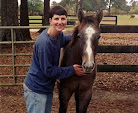
It's only recently that I've really started to appreciate the favor that my LBI horse does me every day by being this kind of demanding teacher. Now that I've started playing with other horses, everything Lupin has drilled me in is there at my fingertips without my having to think about it at all. And I realize now that what he has been doing is teaching me, not just unconscious competence, but excellence, and if this is not exactly proof of how much he loves me, it is proof of how much he cares that my leadership is solid, which in horseville I think may be almost the same thing.
In closing, I'll say one other thing for LBI's, which is that their seeming indifference goes both ways: Lupin may not be easily impressed by my leadership efforts, but he is not radically affected by my leadership failures either. As an example, I've been learning how to play with my donkey from Lupin's back. On our first trail ride, I was all kinds of spazzing out while I tried to manage the donkey, and Lupin calmly soldiered on, paying no mind to my frantic twisting and turning and—I'm embarrassed to say—cursing and swearing. Indeed, it was in large part owing to the fact that Lupin, at least, kept his head that we all came through okay.
The moral of the story? When your LBI remains completely non-plussed as you try to advance your skills, remember that he will also remain non-plussed in circumstances that could easily cause other horses to freak out. And when he does lose it emotionally and pitches the mother of all temper tantrums, try to remain calm and don't take it personally. Because when it's your turn to lose it emotionally, your LBI will be there, calm and not taking it personally.
Note: I am greatly indebted to Dan Thompson for changing my perspective on temper tantrums, and for helping me work through some of Lupin's tougher ones.

April 12, 2012
Listening to your gut
In the days since my last post, here’s what I’ve learned: sometimes you need to manage your internal state—and changing that can make a lot of difference—but sometimes your internal state is telling you that something external needs to change. Translation: sometimes you need to listen to your gut.
While Lupin and I did make some progress with the cow, the tying, and ourselves in certain ways, our sessions did not continue to head in a direction that felt right to me. For one thing, no matter how much progress we seemed to make, Lupin continued to pull back day after day. We were definitely being successful in conjuring a primal fear to confront, but we seemed to be less successful in actually dealing with it.
I began to sense, in fact, that things were unraveling. I knew I couldn’t walk away from this issue now that it was in front of us, but I was concerned that it was going to start to destroy our relationship, and I could see us going back to the brief and bizarre period during which things had gotten so bad that, while I could do highly advanced moves with Lupin, I couldn’t lead him in from the field.
So I retreated some. We started working on tying in a totally different location. Once again we used the blocker tie so he could move his feet, and I confronted Lupin with a series of potentially scary things, each time starting small and close and then getting to where I could run at him with the thing from a distance. I used violently flapping plastic bags right up in his face; I had a friend run at him shouting and wearing a tarp cape; we took turns banging trash can lids right next to him.
I had done some of this before with Lupin without much effect; now, re-energized by his encounters with the cow, Lupin pulled back—sometimes quite violently and for several repetitions. We kept the stimulus up each time until he came back forward, lowered his head, looked directly at the thing instead of turning away, or licked and chewed. Since we were able to control the stimulus (and therefore both the extent of Lupin’s fear and when the stimulus stopped), we began making rapid progress.
Not only did Lupin pull back less and less far with each repetition, he began to get curious and mouth/lick the objects after he came back forward, even though they continued to scare him a little when they were in use. He also stayed very connected to me and looked to me for reassurance in a way that he hadn’t done much around the cow: there, he tended to stay focused on the cow and on getting away. That was what my gut had been responding to.
Being a recovering perfectionist, I try not to get too hung up on progress simply for the sake of reaching a goal, but sometimes a lack of progress is a good indicator that your strategy needs to change. Ultimately, it was the lack of progress that confirmed what my gut had been telling me and gave me the incentive to try something different.
The resulting change in Lupin has been huge. As soon as I saw the difference in the way he responded--not without fear, but with the ability to work through his fear--I finally understood what my gut had been telling me. The cow experience didn't look like learning; this does. And that gives me the motivation I need to commit to a long-term program (with plans to include bicycles, fake cows, llamas, and every potentially scary thing I can think of). I’m even resigned to the fact that I’m just going to have to buy a cow at some point.
But if we can work through a major confidence issue for Lupin, it’s worth the time, the effort, and even cow ownership. And the day that Lupin walks up and licks a cow? That will be priceless.
April 8, 2012
Joy, ease, and lightness
I’ve been working with Lupin on tying for the past week or so and, suffice it to say, it’s been emotionally challenging for both of us. The only way I’ve been able to push Lupin enough to really test his tying is by introducing a cow into the equation, and yeah, that’s done the trick alright. Lupin tends to have bits of unconfidence mixed with defiance that only come out every now and then, so I’m trying to intentionally provoke him a little so that we can deal with these issues in a controlled setting. But even with that, it’s been a little scary.
I’ve been concerned to keep both of us physically safe, and also concerned, as he plunges around on the end of the rope, that I am asking too much of my prey animal. Is it fair of me to ask Lupin, who is genuinely bothered by the cow, to stand tied on the outside of its pen?
But I learned in the Fast Track course that the only way to find out if you are doing the right thing for your horse is to try something and see what happens. There are no guarantees that you’ll get it right. In fact, it’s almost certain that a lot of the time you won’t. But as long as your intention is to do something for your horse rather than to him, you are on the right track even when you make mistakes.
My confidence that I am on the right track with this specific approach, however, was severely tested a couple of nights ago when, just as it seemed we had made real progress, Lupin suddenly blew his lid, started violently pulling back, and even flipped himself over, despite the fact that the blocker tie I used gave him a lot of slack when he needed it.
I had some dark hours of doubt after that. I back-pedaled and did more preparation playing games around the pen, and then I simulated tying by sitting on the fence myself and holding the rope. And I called my left-brain horse guru Alex to get an outside perspective and some moral support.
All of that helped. But what really helped was when I came across a line in one of Eckhart Tolle’s books: “Is there joy, ease, and lightness in everything you do?” I thought about this. What I was doing with Lupin had begun to feel like gutting it out and being stuck on a path that I couldn’t get off of more than enjoying my horsemanship journey.
Today I decided to go out with the attitude of keeping joy, ease, and lightness in our entire session. To me, that translates this way:
Joy.
Staying in and enjoying the present moment ('I'm getting to play with my horse!') instead of focusing on the goal (in this case worrying about getting Lupin to be totally okay with tying). This helped me meet Lupin where he is right now and be pleased with what he is offering and able to do, rather than concerned about what he can’t yet do ('and oh my god! what if he never learns?!'). Less focus on the goal also made it easier to do a lot of approach and retreat—accepting less and rewarding more.
Ease.
I can’t expect zero brace in my horse if I have brace in myself. I focused on my own rhythm and relaxation so that Lupin could have some chance of finding those things himself. We practiced, for instance, turning slowly away from the cow with fluidity rather than beating a hasty retreat.
Lightness.
For me this is mental lightness—not making such a big deal out of everything and having a little bit more of a playful spirit, even in the face of a scary cow. From Lupin, I want physical lightness (which is a good indication of how much he’s trusting me and following my lead). Interestingly, when I focus on his lightness—when I make that the goal—I start to feel more like I’m dancing with my horse and less like we’re confronting something scary.
And everything felt so much better. I was able to problem solve more creatively: I experimented with reverse psychology by demanding a really fast backup in the yo-yo game so that going backwards fast from the cow would start to seem less appealing to Lupin (since it wasn’t his idea any more). I also started to want to be more engaged in the process rather than keeping my distance: I put the rope around a post so that I could control it more rather than relying on the blocker tie I had been using. And I felt much more connected to Lupin throughout the whole session.
So my new goal is to have joy, ease, and lightness in myself and see if maybe, just maybe, Lupin starts to have more of that as well. Whatever happens, though, this way is bound to be a helluva lot more fun.
October 22, 2011
Marian's Manifesto
As with everything in Parelli and in this blog, this manifesto applies to more than horsemanship. Just because it seemed like time . . .
Be yourself, wholly and without controlment. Own who you are, every bit of it, down to the most embarrassing detail. Act in a way that you feel good about without reference to the opinions of others. Be as excited about what you don’t know as you are about what you do know.
Accept what is and look for the good that is already there. If change seems necessary, ask what you can realistically do and don’t feel bad about what you can’t. Before you fight something, ask whether you created the fight through your own need to control, or to win, or to be right.
Practice non-attachment to outcomes. Do your best and be satisfied with that, no matter how imperfect. Trust the process and that you are exactly where you need to be within it. Make fluidity of movement and your relationship with others your primary goals in everything you do. Focus on the joy of doing rather than the triumph of accomplishment.
Live in the present moment. Breathe. Pay attention to sensory input. Look around. Revel in all the amazing things your body can do. Ask whether there is anything at this moment of your life that you can’t handle. Look at things with curiosity, as a child does, rather than with fear or judgment.
Make sleep a priority. Sleep when you are happy because it feels good. Sleep when you are sad because then you really need it. Never, ever feel like a slacker for taking a nap.
August 23, 2011
Leveling the playing field
"If you look for the bad in horses and other people, you're apt to find it, but if you look for the good in them, you're apt to find that instead. But you can't do that unless you also look for the good in yourself."
I went to a yoga class this summer while I was on vacation, and the teacher had us do a meditation on loving kindness. It started with visualizing someone you love. Then you direct that love toward yourself, then a stranger, then someone you're having difficulty with at the moment. I was completely stuck at the second step. I'd never even considered what a self that I could love might look like. I realized that generally I see myself as an amalgam of skills and talents that are in constant need of improvement, and I focus almost exclusively on the parts that need improving. Good lord! Was this also the way I see and treat my horse?
Right about this time I also started reading a book that a couple of friends had recommended. Titled The Introvert Advantage, it bills itself as an effort to level the playing field between introverts and extroverts. The author contends that, in a world where extroverts both out-number and out-speak introverts, it is their values that are considered the norm, and introverts internalize those values and consequently feel inferior when they don't live up to them.
I felt that I was pretty in touch and okay with my introvert nature, but I read the book anyway. And it was, I'll confess, really nice to have someone validating the way I often react to situations, even if I didn't feel that I needed the validation. The author discusses everything from the way that introverts have to budget energy to the way that their brains actually use a different neural route to process information, thereby making them slower but deeper thinkers. Most of all, though, she argues for all the important things that introverts bring to the table, including "the ability to focus deeply, a propensity for thinking outside the box, the strength to make unpopular decisions, and the potential to slow the world down a notch."
It was fascinating to study the physiological differences between extroverts and introverts, and I read the book with a lot of interest, too, because it discusses right-brain and left-brain types, so it has a lot of overlap with Parelli.
But it wasn't until a few weeks later that all this mushed around in my brain and changed something fundamental there. I realized that I'm always hard on myself not only because I focus on the skills I don't have, but because I give myself absolutely no credit for anything that comes easily to me.
Here's how I tend to operate: I find people I admire—people who have skills that I don't. I then compare myself to them, giving them full points for all of their skills, whether they are innate to them or not, and myself points only to the extent that I compare with this person. Now, because I'm only comparing myself to people I admire, and only comparing myself on their terms, who's going to come up short?
So, taking one particular friend that I admire as an example, if I were to assign actual points to the way that I'm subconsciously scoring things, here's how it would stack up:
My friend
|
Me
|
+1 reliable
|
+1 reliable
|
+1 willing to try new things
|
+1 willing to try new things
|
+1 good under pressure
|
+1 persistent, keep at it
|
+1 hands-on skills
| |
+1 decisive
| |
+1 confident
| |
+1 can think and act quickly
| |
+1 dedicated mother
| |
+1 nurse/firefighter
| |
+1 tolerant of family
| |
+1 assertive
| |
TOTAL = 11
|
TOTAL = 3
|
And actually, this is a generous score, because what I'm really doing is not only finding myself lacking in all the things I admire in my friend, but also assigning all the negative corresponding traits to myself. Thus, my naturally extroverted friend gets points for things like being able to think quickly, even though that's not necessarily a skill she worked for, while I beat myself up for being such a slow thinker. So my subconscious score really looks something more like this:
My friend
|
Me
|
+1 reliable
|
+1 reliable
|
+1 willing to try new things
|
+1 willing to try new things
|
+1 good under pressure
|
+1 persistent, keep at it
|
+1 hands-on skills
|
–1 inept
|
+1 decisive
|
–1 indecisive
|
+1 confident
|
–1 second-guessing
|
+1 can think and act quickly
|
–1 slow to think or act
|
+1 dedicated mother
|
–1 overwhelmed by the idea of a family
|
+1 nurse/firefighter
|
–1 largely useless
|
+1 tolerant of family
|
–1 intolerant of noise, commotion, and demands
|
+1 assertive
|
–1 non-assertive
|
TOTAL = 11
|
TOTAL = –5
|
Now, I'm not saying it's a good idea to compare yourself to others, but if you are going to, you should darn well use the same scoring method for both of you! I realized that I needed to give myself points for my innate—if less flashy—qualities, rather than just seeing my differences in a purely negative light.
I thought of a particular incident when this friend lost patience with my non-assertiveness in loading my horse. She was absolutely right that my problem in that instance was a lack of assertiveness, but that didn't, as I initially thought, negate all of my leadership skills.
Yes, I needed to be more assertive (a constant theme for me), but it wasn't just unwillingness to be assertive that caused me to back off. It was also because I was taking the long view of my relationship with my horse and putting that before the goal, and I was willing to give him the benefit of the doubt that it could be a confidence issue for him, and I was willing to be patient. I started to see that these are positive traits in me that, in the long term, stand me in good stead.
That doesn't mean I don't have room to improve and become more balanced, but I'm not, as I initially thought, standing at the bottom of a mountain of achievement with no worthwhile skills. Rather, I have a different skill set and a different leadership style.
After that realization, I re-did my comparison, and here's what I came up with:
My friend
|
Me
|
+1 reliable
|
+1 reliable
|
+1 willing to try new things
|
+1 willing to try new things
|
+1 good under pressure
|
+1 persistent, keep at it
|
+1 hands-on skills
|
+1 conceptual / analytical skills
|
+1 decisive
|
+1 thorough / don’t rush to conclusions
|
+1 confident
|
+1 stick to my principles even when unsure
|
+1 can think and act quickly
|
+1 patient / wait to understand the bigger picture
|
+1 dedicated mother
|
+1 dedicated horse-woman
|
+1 nurse/firefighter
|
+1 teacher/trainer
|
+1 tolerant of family
|
+1 tolerant of living on my own
|
+1 assertive
|
+1 fair-minded / give the benefit of the doubt to others
|
TOTAL = 11
|
TOTAL = 11
|
I also began to realize that life choices don't make one person inferior to another. Take the example of living situations. I’ve always thought that anyone who lives with a family could probably just as easily live alone because, from my perspective, living alone is easy. Meanwhile, the thought of having a family is pretty intimidating to me, so I’m always impressed by people who go that route.
Yet the fact that I don’t choose to have a family doesn’t mean I couldn’t do it, any more than the fact that my friend doesn’t choose to live alone means that she can’t. It’s just a question of having different predilections, neither one inherently better than the other.
If this all sounds obvious, that’s good, because that’s the way it should be. Everyone should walk around realizing that they aren’t less than other people just because they have a different skill set. The trick is to know that AND to believe it.
Happily, as I thought about my view of my horse, I realized that I'm not actually as hard on him as I am on myself. I do tend to be critical, but when I think about the things I love about him, it's his curiosity, his understated playfulness, and his confidence—all things that are innate in him, and that luckily I have not discounted just because of that fact. I have, however, recently been appreciating him and loving him more.
August 21, 2011
Don't make it personal.
This is what I've been telling myself for years, but without any perceptible change in my tendency to be reactive. Taking things personally is, I believe, the root of so much of our emotional baggage, and yet so few things actually are personal. But knowing that doesn't change your perception.
Lupin and I just got back from our first Parelli clinic since Colorado, and it was astoundingly refreshing. I forget, for one thing, how nice it is just to be around Parelli people, who are so calm about things that normal horse folk freak out about (like a horse left loose in the ring during a lesson). And then there's the delightful feeling of your brain really processing things as you hit one A-ha moment after another.
I had a lot of A-ha moments courtesy of Dan. Many of these are cumulative: you've heard it before, you've felt it in action, and yet it can be a long time before it clicks in your brain in a way that is habit-changing rather than just intellectually interesting.
In terms of taking things personally, I watched Dan give a private lesson where the horse was being super dominant. Dan showed the owner how to apply an action/consequence way of thinking to deal with the horse: the horse still gets to choose what to do, but certain choices have consequences. You're not punishing the horse, or forcing him to do something different; you're just showing him that sometimes he needs to make a better choice. So, for instance, rather than chasing the horse out of his space, Dan turned his back on the horse and gave a big yawn and a bigger stretch that just happened to land on the horse's mouth.
Oh. Look what might happen when you stand too close. Action, consequence.
The next morning, we were horse-shoed up, and Lupin was playing his usual game of creeping forward between me and whoever was talking. As I listened to Dan, part of my brain noticed how difficult it was for me to ask Lupin to back up, and I realized that's because I was thinking of being assertive with Lupin in personal terms: that he was challenging me, and doubting my leadership, and I had to prove it to him. Yes, that's probably what was going on, but for Lupin there's no emotion in that--it is truly just a game. For me it's an assault on my sense of myself. Sometimes that makes me angry ("How dare he!"), but more often it just makes me tired ("I can't believe I have to stand up for myself again.")
Note that just the physical action of backing Lupin up takes very little effort--in fact, I was sitting down, and all I had to do was lift my stick. It's the psychic energy of powering up for a perceived emotional confrontation that's draining.
Later, on board, I was asking Lupin to stay on the circle using John's method: if the horse comes off the circle, you get very buzzy--your energy comes up, you use your aids quickly and with a lot of noise--so that the horse wants to get back on the circle where you're calm and quiet. Lupin took this a little personally--or at least got impulsive. I just kept playing my game as he went up to a trot, then a canter, then finally back to down to a trot. But I noticed on one circle toward the end a slight hesitation: I waited longer than I should because I didn't want to apply the aid. Maybe it was because I wanted to believe he was with me, or because I was tired of being assertive, but there it was again: that emotional reluctance to be assertive.
It was a quick mental fix for me, though, when I thought about the action/consequence idea. You don't have to make being assertive a personal issue, and it doesn't have to cost you emotional energy. As soon as I started thinking just in terms of the actions, I had no problem: Lupin comes off the circle, I use my leg. There's no emotion there, whether it be hope for Lupin to do better, worry that I'm doing wrong, feeling inadequate because Lupin isn't with me. It's just an action and a consequence. The circle game was a good one for this because it is so clear and simple.
I'll be curious to see how this realization continues to work for me. I think a lot of the strength of it comes from the fact that it's hard to work off of negative stimuli ("don't make it personal") and much easier to change a habit when you have a positive model to substitute in place of your old mental habit (action/consequence rather than provocation/emotional reaction).
Thanks to Parelli, as always, for giving us so many new positive models.
Subscribe to:
Posts (Atom)